

























“How much electricity does an LED display use?”
This is one of the most common questions asked before purchasing a large LED screen.
A supplier may provide a specification such as:
Maximum Power Consumption: 600 W/m²
But does that mean a 100 m² LED screen will continuously consume 60 kW?
Not necessarily.
The actual electricity consumption of an LED display depends on several factors, including:
- Screen size
- Pixel pitch
- Brightness
- LED package efficiency
- Content being displayed
- Driver IC
- Power supply efficiency
- Operating hours
- Display technology
- Energy-saving functions
More importantly, buyers need to understand the difference between maximum power consumption and average power consumption.
Maximum power is mainly relevant to electrical system and power-distribution design, while average power is generally more useful for estimating actual operating electricity costs.
This guide explains how to calculate LED display power consumption, estimate electricity costs, compare different LED screen specifications and evaluate energy-efficient LED display solutions.
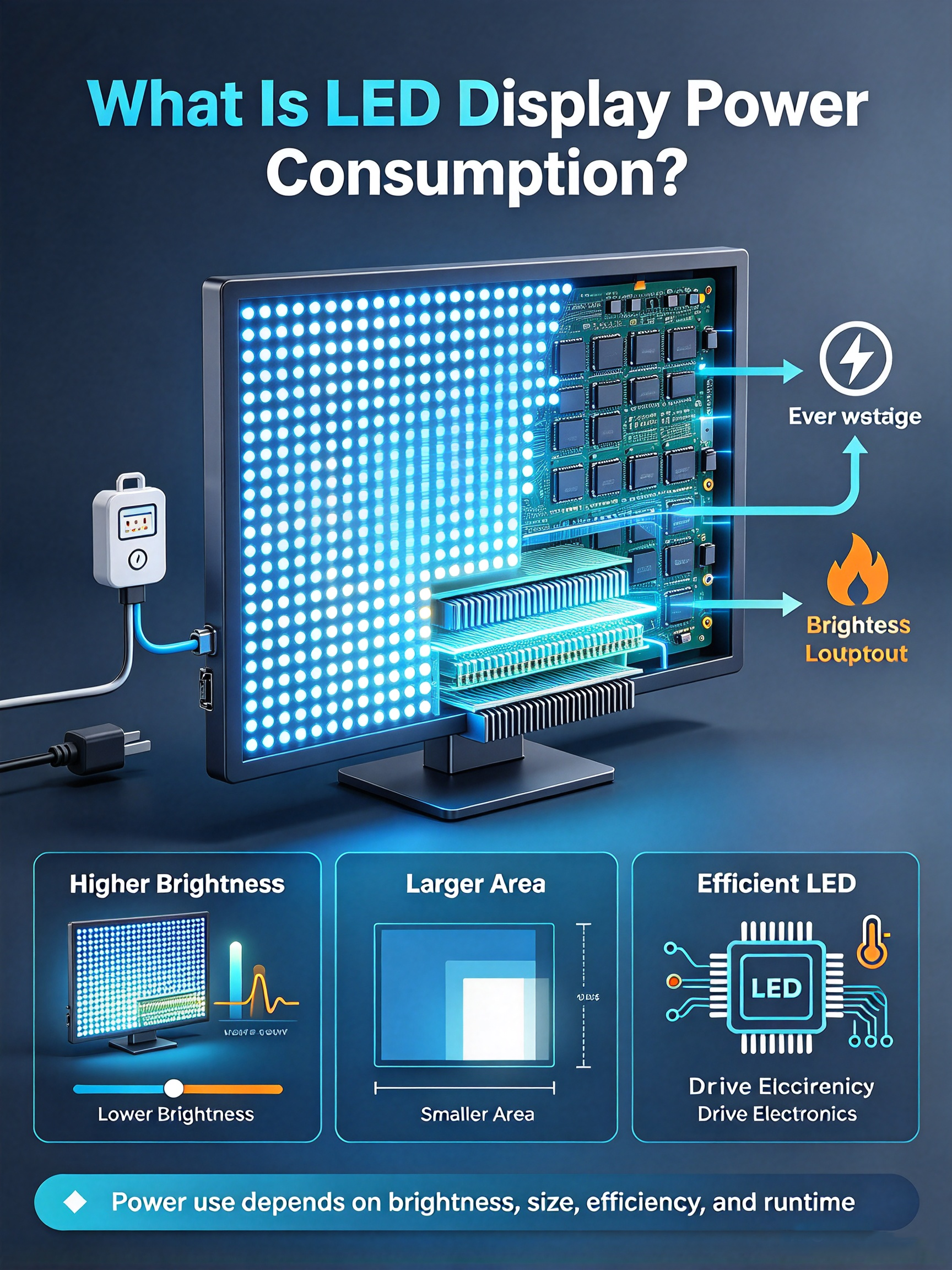
How Much Power Does an LED Display Use?
There is no single power-consumption number that applies to every LED display.
An indoor fine-pitch LED wall, outdoor advertising screen and large stadium display can have significantly different power requirements.
The manufacturer’s technical datasheet should always be the primary source for a specific project.
As a general reference, LED display power consumption is often expressed as:
W/m² — watts per square meter
For example, if a display has a rated maximum power consumption of:
600 W/m²
and the total display area is:
50 m²
the theoretical maximum power is:
600 × 50 = 30,000 W
or:
30 kW
However, this does not mean the display will necessarily consume 30 kWh every hour during normal operation.
That is where maximum and average power consumption become important.
What Is LED Display Power Consumption?
Before calculating electricity costs, it is important to understand several basic electrical units.
What Does Watt (W) Mean?
Watt (W) measures power.
For an LED display, a specification such as:
500 W/m²
means the display’s power demand is rated at 500 watts per square meter under the specified test condition.
What Does Kilowatt (kW) Mean?
1 kilowatt equals:
1,000 watts
Therefore:
10,000 W = 10 kW
Large LED displays are normally discussed in kilowatts because their total power demand can become substantial.
What Does Kilowatt-Hour (kWh) Mean?
A kilowatt-hour measures energy consumption.
For example:
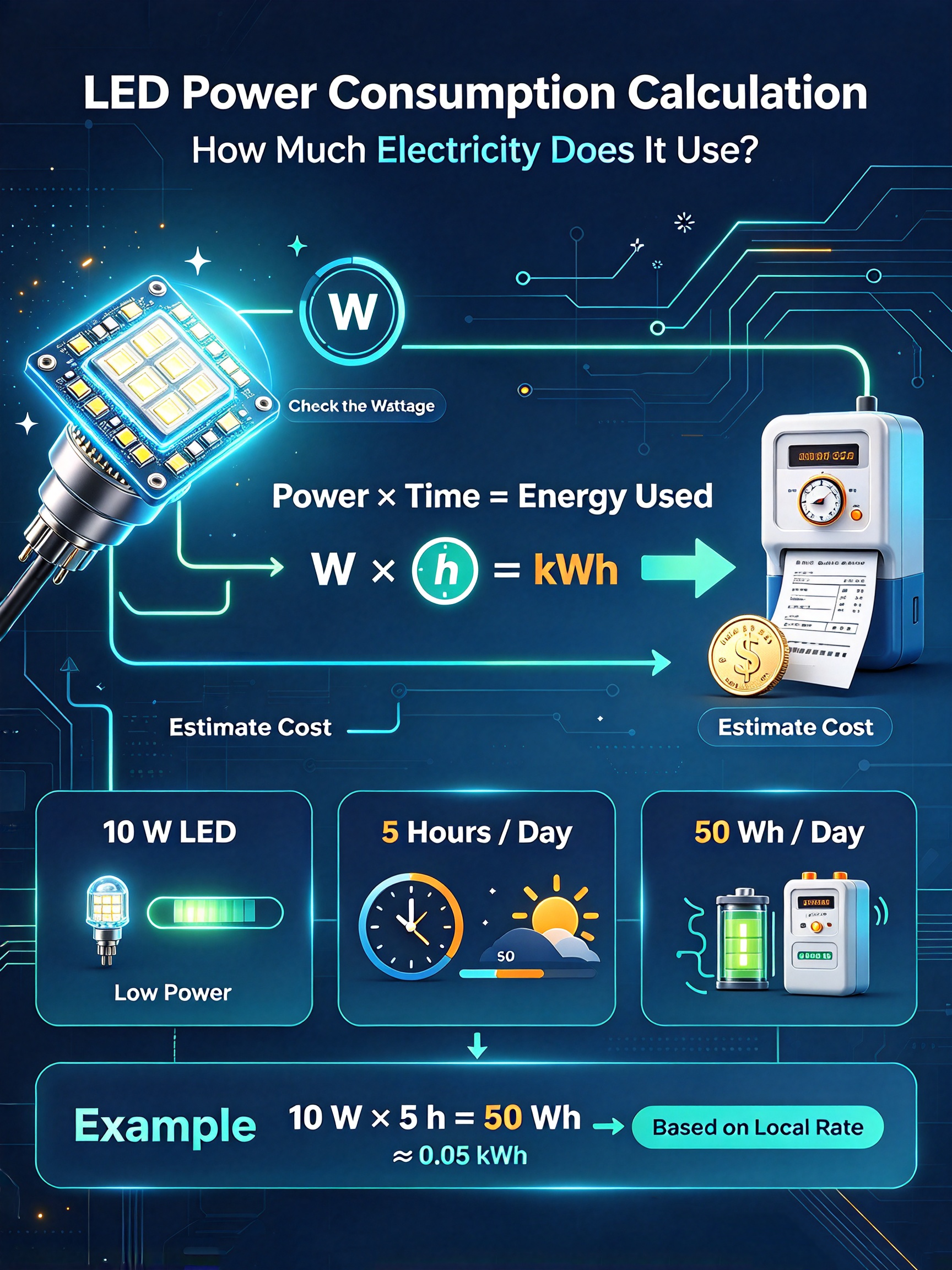
A display consuming 10 kW and operating for 5 hours uses:
10 kW × 5 hours = 50 kWh
This is the unit normally used by electricity providers to calculate energy charges.
Therefore:
W or kW tells you how much power the display needs. kWh tells you how much energy it consumes over time.
What Is LED Display Power Consumption per Square Meter?
LED manufacturers often specify power consumption as W/m² because LED display projects have different physical dimensions.
The basic formula is:
Total Power = Power Consumption per m² × Screen Area
For example:
- Screen area = 40 m²
- Maximum power = 600 W/m²
Then:
40 × 600 = 24,000 W
or:
24 kW maximum power
This is useful when estimating the electrical load of a project.
However, buyers should not automatically use maximum power to calculate the monthly electricity bill.
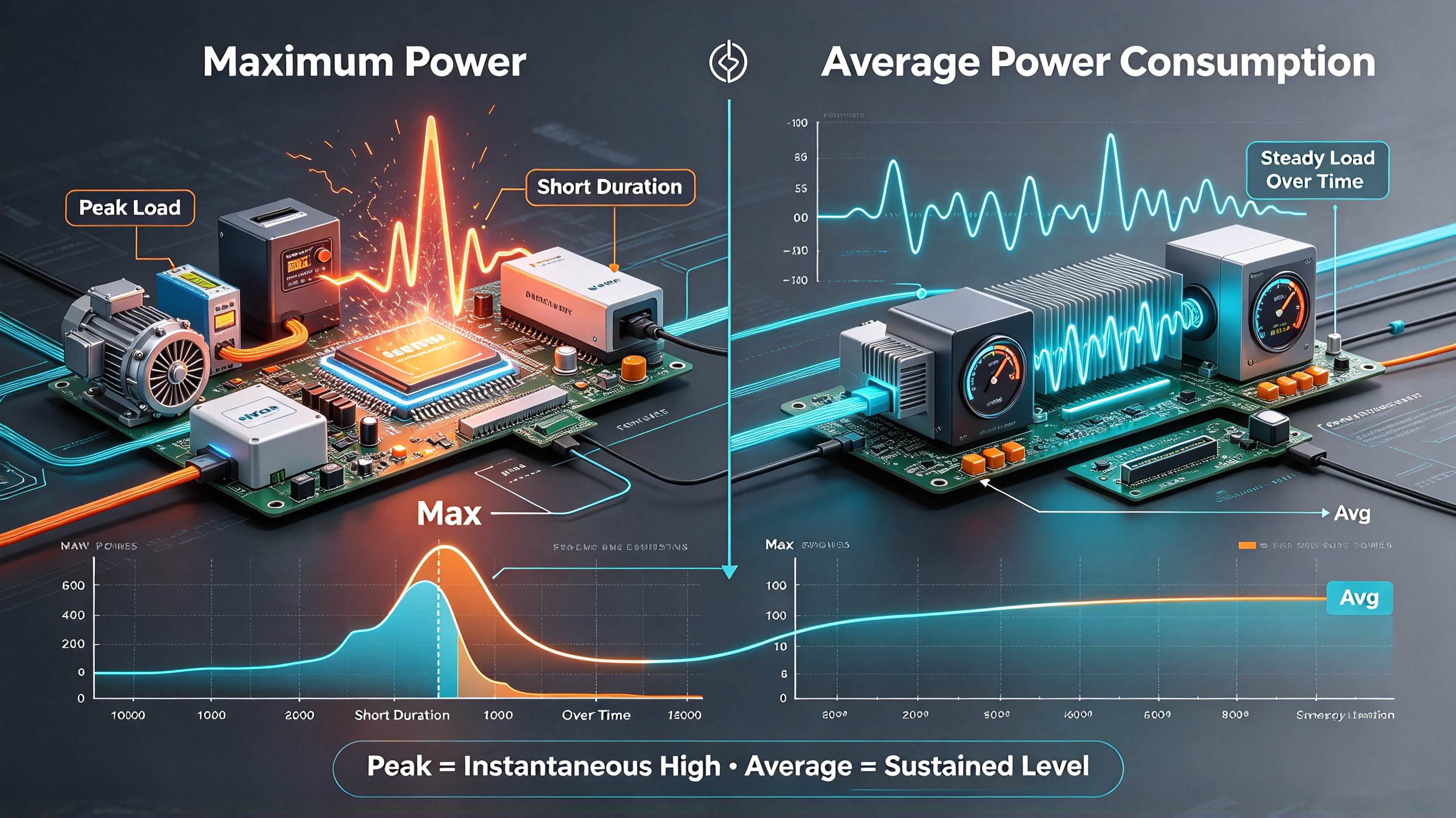
Maximum Power vs Average Power Consumption
This is one of the most important concepts when evaluating LED screen power consumption.
What Is Maximum Power Consumption?
Maximum power consumption represents the display’s power demand under a defined high-load condition.
For example, a full-white image at high brightness can require substantially more power than normal video content.
Maximum power is important for:
- Electrical system design
- Power distribution
- Cable selection
- Circuit protection
- Power supply planning
- Backup power planning
- Infrastructure design
Therefore, engineers should not ignore the maximum power specification.
What Is Average Power Consumption?
Average power consumption represents a more realistic operating condition over time.
An LED display normally shows changing content rather than a full-white image continuously.
For example, a commercial advertising screen may display:
- Video
- Images
- Text
- Logos
- Dark backgrounds
- Bright scenes
- Different advertisements
Therefore, actual power demand changes continuously.
For electricity-cost estimation, average power consumption is generally more relevant than maximum power consumption.
Which Power Rating Should You Use for Electrical Design?
Use the manufacturer’s maximum power specification as the basis for electrical-load planning, subject to the manufacturer’s engineering guidance.
It helps determine whether the site’s electrical infrastructure can support the display.
Which Power Rating Should You Use to Estimate Electricity Cost?
For a practical electricity-cost estimate, use:
Average Power × Operating Hours
rather than simply multiplying the maximum rated power by every operating hour.
However, the average value must correspond to a meaningful operating condition.
When comparing suppliers, always ask:
Under what brightness, content and test conditions was the average power measured?
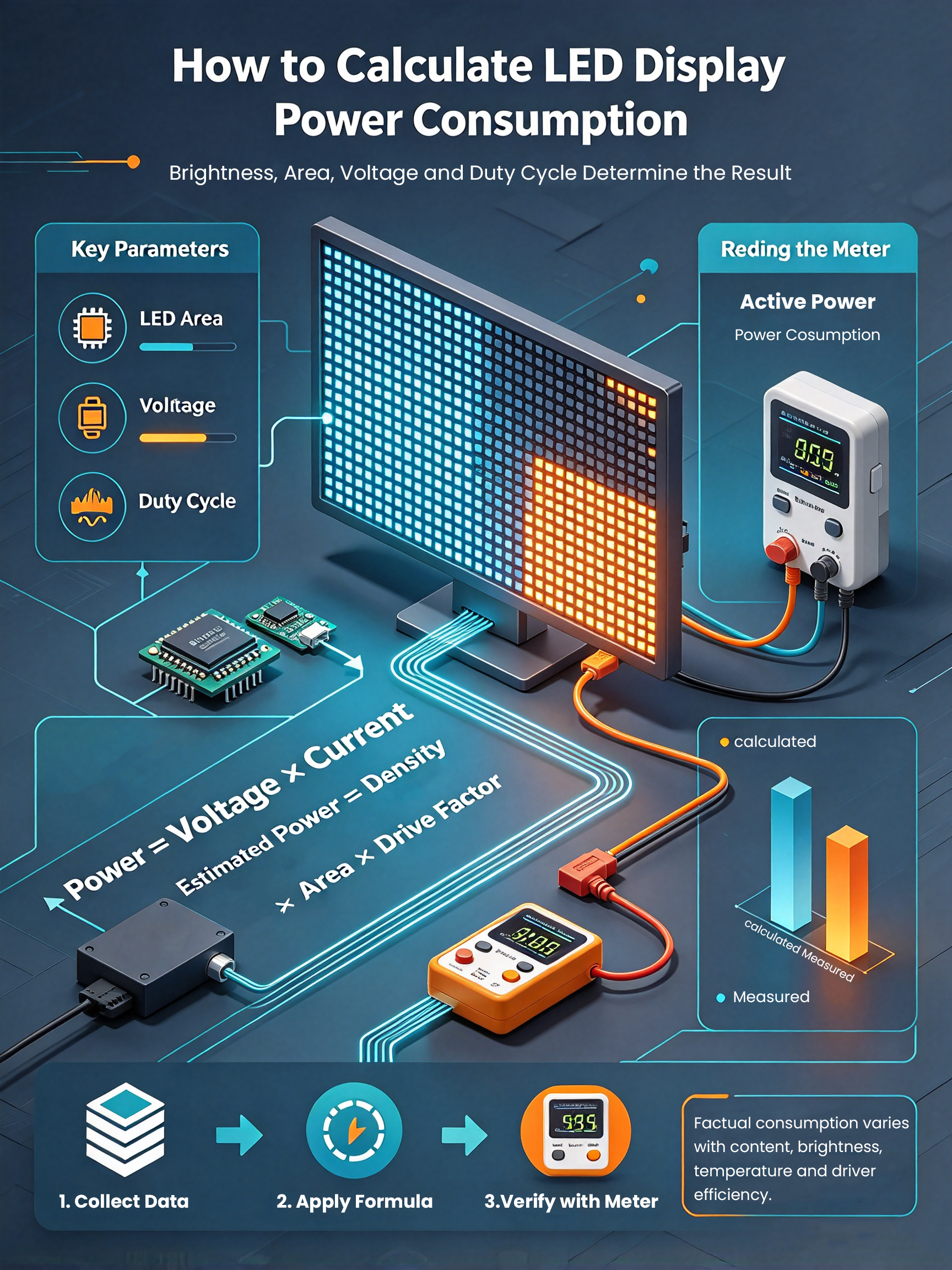
How to Calculate LED Display Power Consumption
The calculation can be divided into several simple steps.
Step 1: Calculate the Screen Area
The first step is to determine the total display area.
Screen Area = Width × Height
For example:
10 m × 5 m = 50 m²
Step 2: Find the Power Consumption per Square Meter
Suppose the manufacturer’s specification states:
Maximum Power = 600 W/m²
and:
Average Power = 250 W/m²
These are two different values and should not be treated as interchangeable.
Step 3: Calculate Maximum Power
Using the maximum power specification:
600 W/m² × 50 m² = 30,000 W
Therefore:
Maximum Power = 30 kW
This value can help engineers evaluate electrical infrastructure requirements.
Step 4: Calculate Average Operating Power
Using the average power specification:
250 W/m² × 50 m² = 12,500 W
Therefore:
Average Power = 12.5 kW
Step 5: Calculate Daily Electricity Consumption
If the LED display operates for 12 hours per day:
12.5 kW × 12 hours = 150 kWh/day
Therefore, the estimated daily energy consumption is:
150 kWh
Step 6: Calculate Electricity Cost
Suppose the electricity rate is:
$0.15/kWh
Then:
150 kWh × $0.15 = $22.50/day
So the estimated daily electricity cost is:
$22.50
This is an example calculation rather than a universal operating cost. Actual electricity prices and display power consumption vary by location, product and operating conditions.
LED Display Power Consumption Calculator Formula
For project planning, the following formulas can be used.
- Screen Area — Area = Width × Height
- Maximum Power — Maximum Power (kW) = Screen Area × Maximum W/m² ÷ 1,000
- Average Power — Average Power (kW) = Screen Area × Average W/m² ÷ 1,000
- Daily Energy Consumption — Daily kWh = Average Power × Operating Hours
- Monthly Energy Consumption — Monthly kWh = Daily kWh × Operating Days
- Annual Energy Consumption — Annual kWh = Daily kWh × Operating Days per Year
- Electricity Cost — Electricity Cost = Energy Consumption (kWh) × Electricity Rate
These formulas can be used as a basic LED display power consumption calculator.
How Much Does an LED Screen Cost to Run Per Day?
Let’s use a practical example.
Example Project
- Screen size: 10 m × 5 m
- Screen area: 50 m²
- Average power: 250 W/m²
- Operating time: 12 hours/day
- Electricity rate: $0.15/kWh
Average power:
250 × 50 ÷ 1,000 = 12.5 kW
Daily consumption:
12.5 × 12 = 150 kWh
Daily electricity cost:
150 × $0.15 = $22.50
Therefore:
Estimated daily electricity cost = $22.50
Again, this is an illustrative example. Actual results depend on the display’s measured operating power, brightness, content and local electricity rate.
How Much Does an LED Display Cost to Run Per Month?
Using the same example:
150 kWh/day × 30 days = 4,500 kWh/month
At:
$0.15/kWh
Monthly electricity cost:
4,500 × $0.15 = $675/month
Therefore:
Estimated monthly electricity cost = $675
For projects operating fewer days per month, replace 30 with the actual number of operating days.
How Much Does an LED Display Cost to Run Per Year?
Using the same example:
150 kWh/day × 365 days = 54,750 kWh/year
Annual electricity cost:
54,750 × $0.15 = $8,212.50
This demonstrates why electricity consumption can become an important part of the total cost of ownership (TCO) of a large LED display.
For a display operating for many years, the initial purchase price is only one part of the overall cost.
What Factors Affect LED Display Power Consumption?
LED display power consumption is influenced by multiple technical and operating factors.
Screen Size
The larger the display area, the higher the total power requirement will generally be.
A 100 m² display will normally require more total power than a 10 m² display using comparable technology.
However, power should be evaluated in:
W/m²
before comparing different screen sizes.
Pixel Pitch
Pixel pitch determines the distance between LED pixels.
Smaller pixel pitch means higher pixel density.
This changes the number of LEDs and electronic components used per unit area and can affect power consumption.
However:
Smaller pixel pitch does not automatically mean higher power consumption in every product.
Actual power depends on:
- LED efficiency
- Driver IC
- PCB design
- Brightness
- Driving method
- Power supply
- Product architecture
Therefore, buyers should compare the actual W/m² specification of the products being considered.
Brightness
Brightness is one of the most important factors affecting LED display power consumption.
Outdoor LED displays often require higher brightness than indoor displays because they must remain visible under strong ambient light.
For example:
- Indoor conference room
- Retail store
- Outdoor billboard
- Stadium
- Highway advertising screen
all have different brightness requirements.
Higher brightness can require more electrical power.
This is why choosing the right brightness for the application is often more efficient than simply choosing the highest brightness available.
Display Content
The content being displayed can affect actual power consumption.
A mostly dark image generally requires less LED output than a full-white image at maximum brightness.
This is another reason why:
Maximum power ≠ Actual average power
LED Package Efficiency
The efficiency of the LED package affects how much light output can be achieved from a given electrical input.
Higher-efficiency LED components can contribute to better overall energy performance.
However, LED package efficiency should be evaluated together with the complete display system.
Driver IC
The driver IC controls LED current and pixel operation.
Driver architecture can influence:
- Electrical efficiency
- Refresh performance
- Grayscale
- Current control
- Thermal performance
Therefore, power consumption should not be evaluated only by looking at the LED lamp itself.
Power Supply Efficiency
The power supply converts electrical power into the voltage required by the LED display.
Power-supply efficiency affects how much input power is required to deliver the necessary output power.
For a large LED installation, even small efficiency differences can become meaningful over thousands of operating hours.
Does Pixel Pitch Affect LED Screen Power Consumption?
Yes, pixel pitch can influence power consumption, but it should not be treated as the only determining factor.
For example, P1.5, P2.5, P3.9 and P6 LED displays have different pixel densities.
A higher pixel density can mean more LED components per square meter.
But actual power consumption depends on the complete product design.
When comparing two LED displays, ask suppliers for:
- Maximum power W/m²
- Average power W/m²
- Brightness
- Pixel pitch
- LED package
- Driver IC
- Power supply
- Test conditions
The actual specification is more useful than assuming power consumption from pixel pitch alone.
How Does Brightness Affect LED Screen Power Consumption?
Brightness and energy consumption are closely related.
Indoor LED Displays
Indoor LED displays generally operate at lower brightness because ambient light is controlled.
Examples include:
- Conference rooms
- Meeting rooms
- Control rooms
- Shopping malls
- Exhibition halls
Using excessive brightness in these environments may provide little practical benefit while increasing energy consumption.
Outdoor LED Displays
Outdoor displays face sunlight and require higher brightness.
Examples include:
- Outdoor advertising
- Stadiums
- Transportation hubs
- Large commercial buildings
- DOOH screens
For outdoor applications, brightness should be selected according to the viewing environment rather than simply choosing the highest available specification.
Automatic Brightness Adjustment
Automatic brightness adjustment can reduce unnecessary power consumption by adapting screen brightness to ambient lighting conditions.
For example:
Daytime → Higher brightness
Nighttime → Lower brightness
This can improve both viewing comfort and energy efficiency.
What Is Common Cathode LED Display Technology?
Common cathode is one of the technologies used to improve LED display energy efficiency.
Traditional common-anode designs use a shared positive connection, while common-cathode designs use a shared negative connection with more independent control of the RGB channels.
The underlying electrical architecture can help control the operating voltage and current requirements of different LED colors more efficiently.
Common Anode vs Common Cathode
| Feature | Common Anode | Common Cathode |
| Electrical architecture | Shared positive | Shared negative |
| RGB control | Conventional | More independent current/voltage control |
| Energy efficiency | Product dependent | Can improve efficiency |
| Thermal performance | Product dependent | Can reduce unnecessary heat |
| Power consumption | Depends on design | Depends on design |
| Energy-saving potential | Product dependent | Often used for energy-efficient designs |
Why Can Common Cathode Reduce Energy Consumption?
Common-cathode technology can help reduce unnecessary electrical losses by allowing more precise control of the voltage and current requirements of different RGB LEDs.
This can reduce heat generation and improve energy efficiency in appropriately designed LED displays.
However:
Common cathode does not automatically mean that every common-cathode LED display consumes less power than every common-anode display.
The actual result depends on the complete product architecture.
How to Reduce LED Display Power Consumption
Reducing electricity costs does not necessarily mean choosing the lowest-power product available.
The better approach is to match the display’s performance with the actual application.
Choose the Right Brightness
Do not specify excessive brightness when the application does not require it.
Use Automatic Brightness Control
Adjusting brightness according to ambient light can reduce unnecessary energy consumption.
Choose Efficient LED Components
LED efficiency contributes to the overall energy performance of the display.
Consider Common Cathode Technology
For suitable outdoor and high-brightness applications, common-cathode LED technology can be considered as part of an energy-efficiency strategy.
Evaluate Power Supply Efficiency
An efficient power supply can reduce energy losses.
Consider Dynamic Energy-Saving Functions
Some LED display systems provide energy-saving functions that adjust operating conditions based on image content or brightness requirements.
Optimize Operating Hours
If the display does not need to operate 24 hours a day, scheduling operating periods can directly reduce electricity consumption.
For advertising and commercial displays, operating schedules can be aligned with:
- Store opening hours
- Advertising schedules
- Traffic patterns
- Event schedules
- Day/night conditions
LED Display Power Consumption vs Total Cost of Ownership
When buying an LED display, purchase price is only one part of the cost.
A more complete calculation includes:
Initial Purchase Cost
+
Electricity Cost
+
Maintenance Cost
+
Cooling Cost
+
Spare Parts
+
Replacement Cost
=
Total Cost of Ownership
This is particularly important for large LED displays that operate for many hours every day.
For example, a product with a lower initial purchase price may not necessarily have the lowest long-term operating cost if it requires significantly more electricity or maintenance.
Therefore, B2B buyers should evaluate:
Purchase Price + Energy Consumption + Maintenance + Service
rather than price alone.
How to Compare LED Display Power Consumption Between Suppliers
Comparing two LED displays based only on one number can be misleading.
For example:
Supplier A:
Maximum Power: 500 W/m²
Supplier B:
Maximum Power: 600 W/m²
At first glance, Supplier A appears to consume less power.
But what if:
- Supplier A’s brightness is 4,000 nits
- Supplier B’s brightness is 6,000 nits
- Supplier A uses a different test condition
- Supplier B provides a lower average operating power
- The two products use different power supplies
The comparison is no longer straightforward.
Therefore, ask every supplier for the same information.
| What to Ask | Why It Matters |
| Maximum power W/m² | Electrical system design |
| Average power W/m² | Electricity estimation |
| Brightness | Performance vs energy |
| Test condition | Fair comparison |
| Full-white power | Maximum-load reference |
| Typical operating power | Real-world estimation |
| Power supply efficiency | System efficiency |
| Energy-saving technology | Long-term operating cost |
| Operating temperature | Reliability |
| Warranty | Long-term support |
The key principle is:
Never compare LED display power consumption numbers without comparing the conditions under which they were measured.
LED Display Power Consumption Calculation Example
Consider a commercial outdoor LED display project.
Project Parameters
- Width: 10 m
- Height: 5 m
- Screen area: 50 m²
- Maximum power: 600 W/m²
- Average power: 250 W/m²
- Operating hours: 12 hours/day
- Electricity rate: $0.15/kWh
Maximum Electrical Load
600 × 50 ÷ 1,000
= 30 kW
This value can be used as a reference for electrical system planning.
Average Operating Power
250 × 50 ÷ 1,000
= 12.5 kW
Daily Energy Consumption
12.5 × 12
= 150 kWh/day
Daily Electricity Cost
150 × $0.15
= $22.50/day
Monthly Electricity Cost
$22.50 × 30
= $675/month
Annual Electricity Cost
$22.50 × 365
= $8,212.50/year
This example demonstrates why average power consumption and operating hours are important when estimating the real operating cost of an LED display.
Actual results will vary depending on the display model, brightness, content, operating schedule, electricity rate and other conditions.
LED Display Power Consumption Checklist for Buyers
Before purchasing an LED display, ask the supplier:
- ☐ What is the maximum power consumption in W/m²?
- ☐ What is the average power consumption in W/m²?
- ☐ Under what conditions was the power measured?
- ☐ What brightness level was used?
- ☐ Is the maximum value based on full-white content?
- ☐ What is the typical operating power?
- ☐ What LED package is used?
- ☐ What driver IC is used?
- ☐ What power supply is used?
- ☐ What is the power supply efficiency?
- ☐ Does the product use common cathode technology?
- ☐ Does it support automatic brightness adjustment?
- ☐ Does it have energy-saving functions?
- ☐ What is the expected operating environment?
- ☐ Can the supplier provide a product datasheet?
This checklist makes it easier to compare different LED display suppliers on a consistent basis.
FAQ: LED Power Consumption
1. How much electricity does an LED display use?
LED display electricity consumption depends on screen size, power consumption per square meter, brightness, content, operating hours and display technology. Use the manufacturer’s average power specification for a practical operating estimate.
2. How do you calculate LED screen power consumption?
First calculate the screen area, then multiply it by the manufacturer’s power consumption per square meter. Power = Screen Area × W/m². For electricity consumption: Energy = Power × Operating Hours.
3. How much power does an LED screen use per square meter?
Power consumption varies by product. Indoor and outdoor displays, pixel pitches, brightness levels and LED technologies can have different W/m² specifications. Always use the actual manufacturer’s datasheet for project calculations.
4. What is the difference between maximum and average LED power consumption?
Maximum power represents a high-load operating condition and is important for electrical system design. Average power represents a more typical operating condition and is generally more useful for estimating electricity costs.
5. Which power rating should I use to calculate electricity cost?
Use the manufacturer’s average or measured typical operating power when available, together with actual operating hours. Do not automatically multiply maximum power by every operating hour.
6. Which power rating should I use for electrical system design?
Maximum power should generally be considered when planning electrical load and infrastructure, subject to the manufacturer’s engineering requirements.
7. Does pixel pitch affect LED screen power consumption?
Pixel pitch can affect power consumption because it changes pixel density and component density. However, actual power consumption also depends on brightness, LED efficiency, driver IC, PCB design, power supply and other factors.
8. Does brightness affect LED display power consumption?
Yes. Higher brightness generally requires more LED output and can increase power consumption. Selecting the appropriate brightness for the application can help avoid unnecessary energy use.
9. Does common cathode reduce LED display power consumption?
Common-cathode technology can improve energy efficiency in appropriately designed LED displays by allowing more controlled RGB voltage and current management. However, the actual power-saving result depends on the complete product design.
10. How much does a 100 m² LED screen cost to operate?
There is no universal answer. You need the display’s average W/m², operating hours and local electricity rate. For example: 100 m² × 250 W/m² = 25 kW average power. At 12 hours/day: 25 × 12 = 300 kWh/day. At $0.15/kWh: 300 × $0.15 = $45/day. This is only an example; actual power consumption should come from the specific product datasheet or measured operating data.
11. How can I reduce LED display electricity costs?
Consider appropriate brightness, automatic brightness adjustment, efficient LED components, common-cathode technology, efficient power supplies, energy-saving functions and optimized operating schedules.
12. What information should I request from an LED display supplier?
Ask for maximum and average W/m², brightness, test conditions, LED package, driver IC, power supply efficiency, energy-saving technology and other relevant technical specifications.
How LEDFUL Can Help Optimize LED Display Power Consumption
LEDFUL evaluates LED display power consumption as part of the complete project configuration.
Instead of choosing a display based only on maximum brightness or pixel pitch, the project should consider:
- Application
- Screen size
- Indoor or outdoor environment
- Required brightness
- Pixel pitch
- Operating hours
- Content characteristics
- Power consumption
- Energy-saving technology
- Maintenance requirements
For outdoor advertising applications, for example, high brightness may be necessary during the daytime, while brightness can be adjusted according to ambient conditions at other times.
For energy-sensitive projects, LEDFUL can also evaluate suitable display technologies and configurations based on the project’s performance and operating requirements.
The goal is not simply to choose a display with the lowest advertised power consumption.
The goal is to find the right balance between:
Brightness + Image Quality + Reliability + Energy Efficiency + Total Cost of Ownership
Planning an LED Display Project?
If you are comparing LED display suppliers, don’t ask only:
“How much does the LED screen cost?”
Also ask:
“How much will this LED display cost to operate over its lifetime?”
Before making a purchasing decision, evaluate:
- Initial purchase price
- Maximum power consumption
- Average power consumption
- Electricity cost
- Brightness requirements
- Energy-saving technology
- Maintenance cost
- Spare parts
- Warranty
- Technical support
- Expected operating hours
For a large B2B LED display project, these factors can have a significant impact on the total cost of ownership.
If you are planning an indoor LED video wall, outdoor advertising LED screen, stadium LED display, retail LED wall, conference display or other commercial LED project, send LEDFUL your project size, application, brightness requirement and operating schedule.
LEDFUL can help evaluate the appropriate display configuration and estimate the power and operating requirements before purchase.