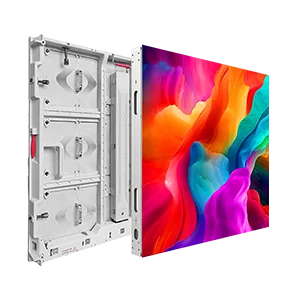
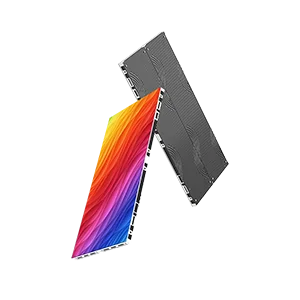
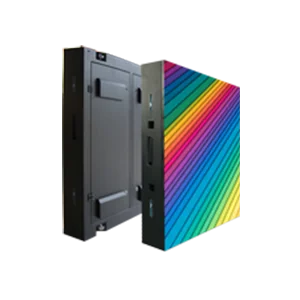
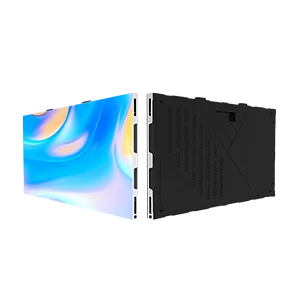








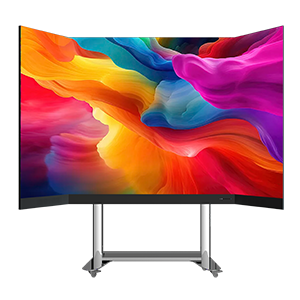
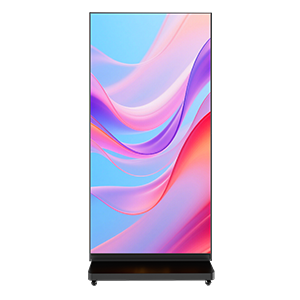
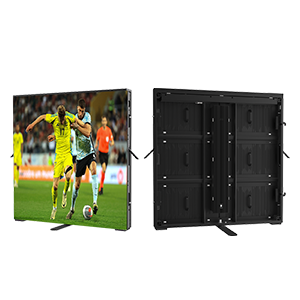
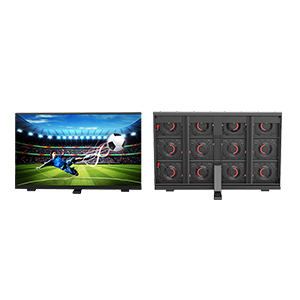
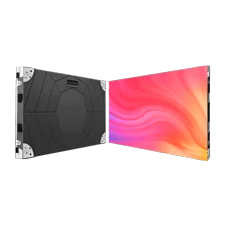
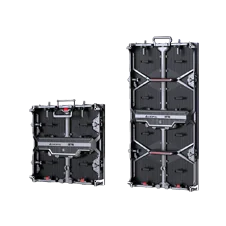
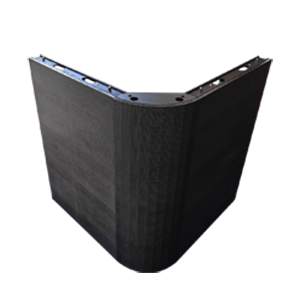
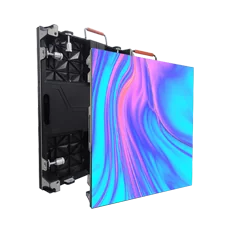
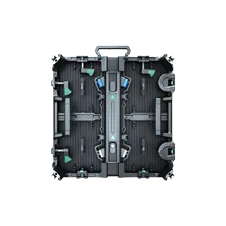
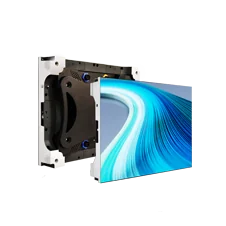
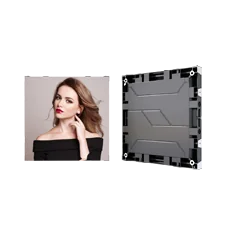
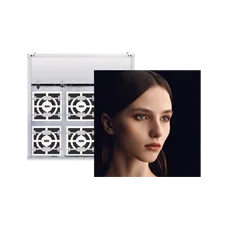






























What does 4K mean for an LED display? Learn how resolution, pixel pitch, screen size, viewing distance and content affect whether a 4K LED wall is worth the investment.
Introduction
“We need a 4K LED wall” is not enough to define an LED display project.
For an LED display, 4K does not automatically tell you the physical screen size, pixel pitch, viewing distance, or image quality. A display can accept a 4K signal without having a native 3840 × 2160 pixel canvas.
That distinction matters because the right LED display should be selected around the project—not around a single specification.
This guide explains what 4K means for direct-view LED displays, how pixel pitch determines physical resolution, when 4K is actually useful, and what buyers should evaluate before investing in a 4K LED wall.
What Is a 4K LED Display?
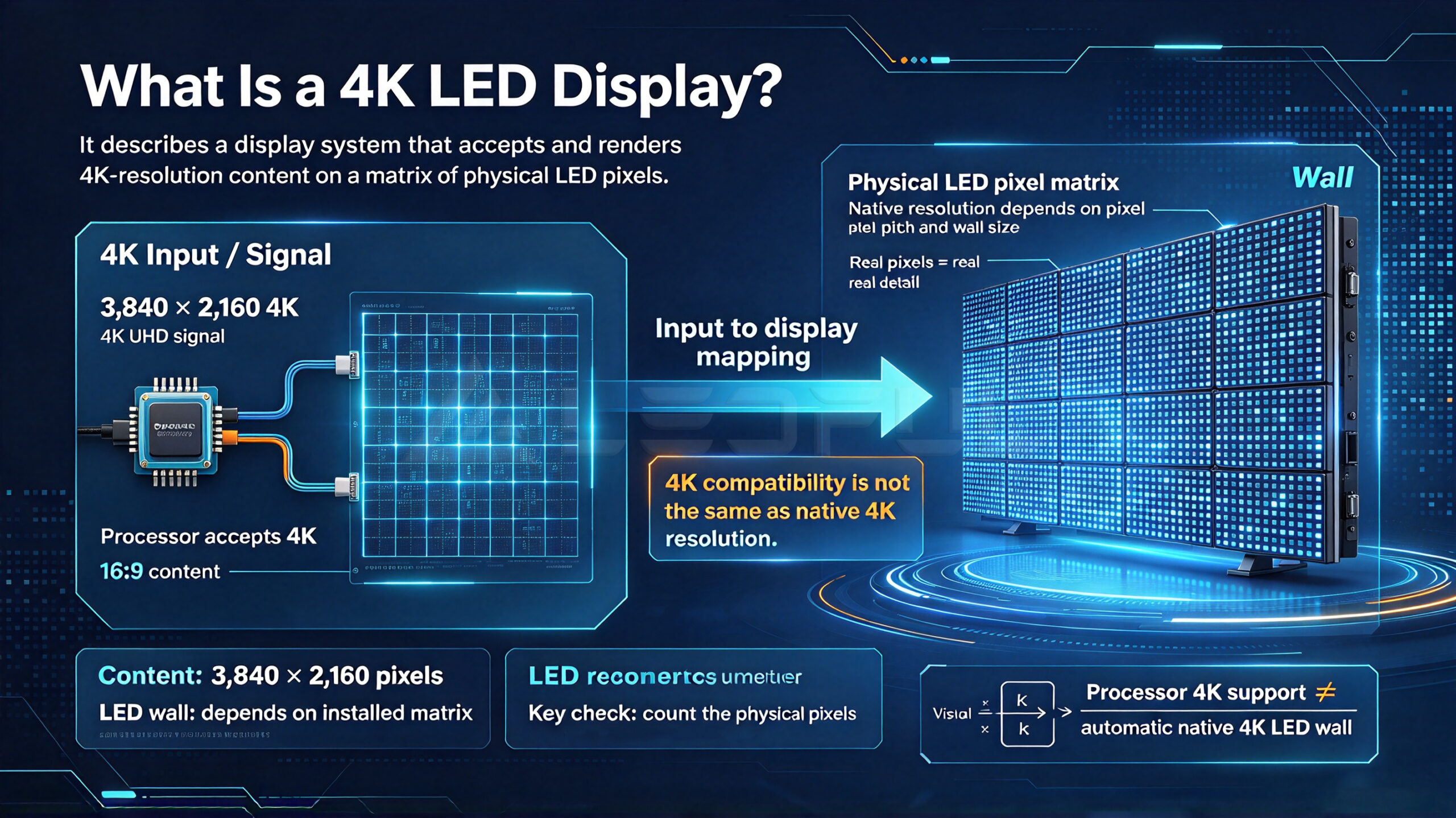
A 4K LED display is an LED video wall designed to deliver an image raster of approximately 3,840 × 2,160 pixels, commonly called 4K UHD.
However, the phrase “4K LED display” is often used too broadly in the market. It may refer to:
– A display with a native 3840 × 2160 LED pixel canvas
– An LED wall that accepts or processes a 4K input signal
– An LED wall large enough to display 4K content, but with lower native resolution
– A fine-pitch LED display marketed for high-resolution applications
These are not technically identical.
What Does 4K Mean?
4K UHD normally refers to:
– Horizontal resolution: 3,840 pixels
– Vertical resolution: 2,160 pixels
– Total pixels: approximately 8.29 million
– Aspect ratio: 16:9
Compared with 1920 × 1080 Full HD, 4K contains approximately four times as many pixels.
For LED displays, however, the important question is not simply whether the processor accepts 4K. The key question is:
How many physical LED pixels does the wall actually have?
Is Every 4K LED Screen a Native 4K Display?
No.
A video processor can accept a 3840 × 2160 source and scale it to an LED wall with a lower native pixel count.
For example, an LED wall might receive 4K video but physically contain fewer than 3840 × 2160 pixels. The processor scales the source to fit the LED canvas.
Therefore, when a project specification says “4K LED wall,” buyers should clarify whether they mean:
– 4K input compatibility
– 4K content support
– Or native 3840 × 2160 LED resolution
For professional installations, this distinction should be confirmed before quotation and system design.
How Does Pixel Pitch Affect 4K LED Display Resolution?
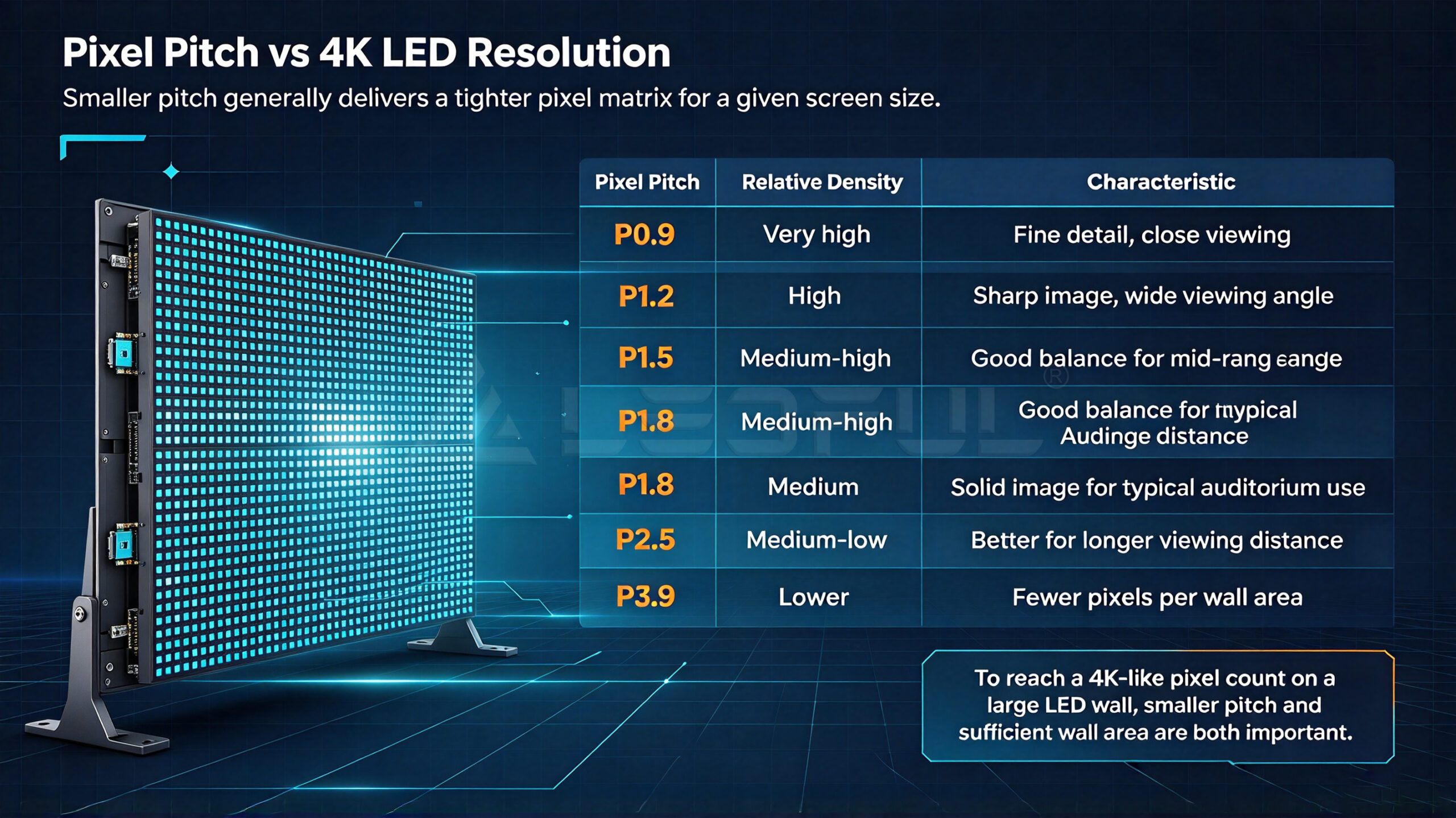
Pixel pitch is the distance between the centers of two adjacent LED pixels, normally measured in millimeters.
Examples include:
– P0.9
– P1.2
– P1.5
– P1.8
– P2.5
– P3.9
The smaller the pixel pitch, the more pixels can fit into a given physical area.
This means pixel pitch directly affects:
– Pixel density
– Native resolution
– Minimum comfortable viewing distance
– Screen size required for a target resolution
– LED module and cabinet configuration
– Processing requirements
– Project cost
Why Smaller Pitch Means Higher Pixel Density
Consider two LED walls with the same physical dimensions.
A P1.5 wall contains substantially more pixels than a P3.9 wall because each pixel occupies less physical space.
This makes smaller-pitch displays more suitable for applications where viewers are close to the screen and fine image detail is important.
However, smaller pixel pitch also increases the number of LEDs and processing data required. It usually increases the investment as well.
Pixel Pitch vs Physical Screen Size
A critical point is that 4K does not correspond to one fixed physical screen size.
The physical size required to reach approximately 3840 × 2160 pixels depends on the pixel pitch.
The following examples are theoretical approximations for a 16:9 wall:
Pixel Pitch | Approx. Width for 3840 Pixels | Approx. Height for 2160 Pixels
P0.9 | 3.46 m | 1.94 m
P1.2 | 4.61 m | 2.59 m
P1.5 | 5.76 m | 3.24 m
P1.8 | 6.91 m | 3.89 m
P2.5 | 9.60 m | 5.40 m
P3.9 | 14.98 m | 8.42 m
These figures are theoretical calculations. Real LED walls must also follow module and cabinet dimensions, so the final physical resolution may differ from the mathematical ideal.
This is why “4K” should never be specified independently from pixel pitch and screen dimensions.
4K LED Display vs 1080P LED Display
The difference between 4K and 1080P is straightforward at the signal level, but the practical difference on an LED wall depends on screen size and viewing conditions.
Feature | 1080P | 4K
Resolution | 1920 × 1080 | 3840 × 2160
Approx. Pixel Count | 2.07 million | 8.29 million
Detail | Lower | Higher
Suitable Content | HD / Full HD | UHD / 4K
Data & Processing | Lower | Higher
Typical Application | General display | High-detail applications
A 4K source does not automatically make a display visually better if the physical LED wall cannot reproduce the additional detail.
For example, if viewers are far away from a large stadium screen, the difference between native 4K and a lower-resolution wall may not be as important as brightness, contrast, viewing angle, refresh rate, and visibility.
In contrast, viewers sitting close to a conference-room LED wall can benefit much more from high pixel density.
Do You Really Need a 4K LED Display?
The answer depends on the application.
A 4K LED display is not automatically necessary for every project. The correct configuration depends on viewing distance, screen size, content, camera requirements, and the amount of detail viewers need to see. https://www.ledful.com/ledful-outdoor-led-display-solution
Conference Rooms
Conference rooms are one of the clearest examples where fine-pitch and high-resolution LED can provide practical value.
Participants may sit only a few meters away from the screen while viewing:
– PowerPoint presentations
– Excel spreadsheets
– Product details
– Video conferencing windows
– Text-heavy documents
– Product demonstrations
If the screen is large and viewers are close, a coarse pixel pitch can make text and fine graphics appear less detailed.
For these environments, pixel pitch and viewing distance should be evaluated before deciding whether native 4K is required.

Broadcast & Virtual Production
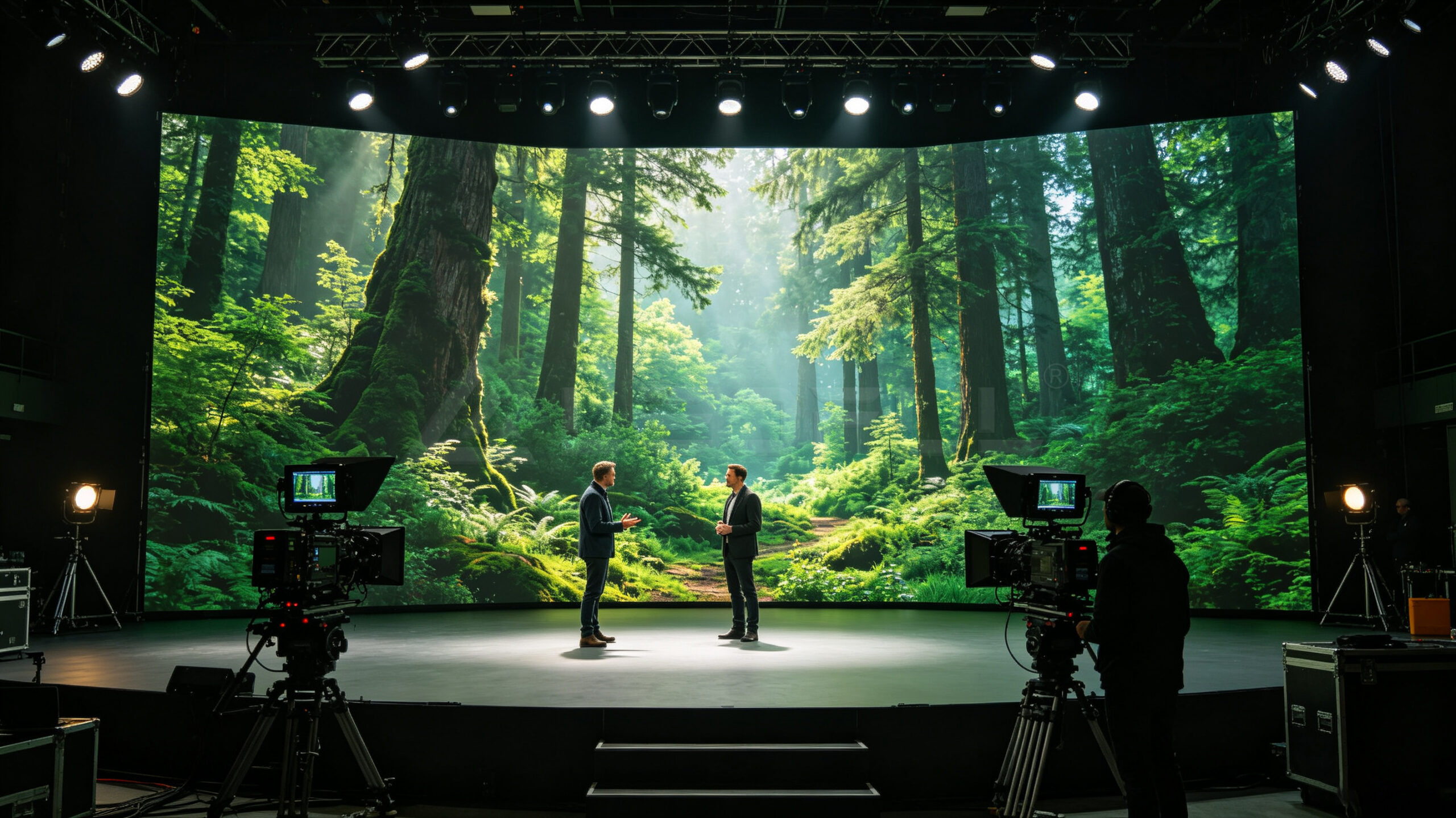
Broadcast studios and virtual production environments have different requirements.
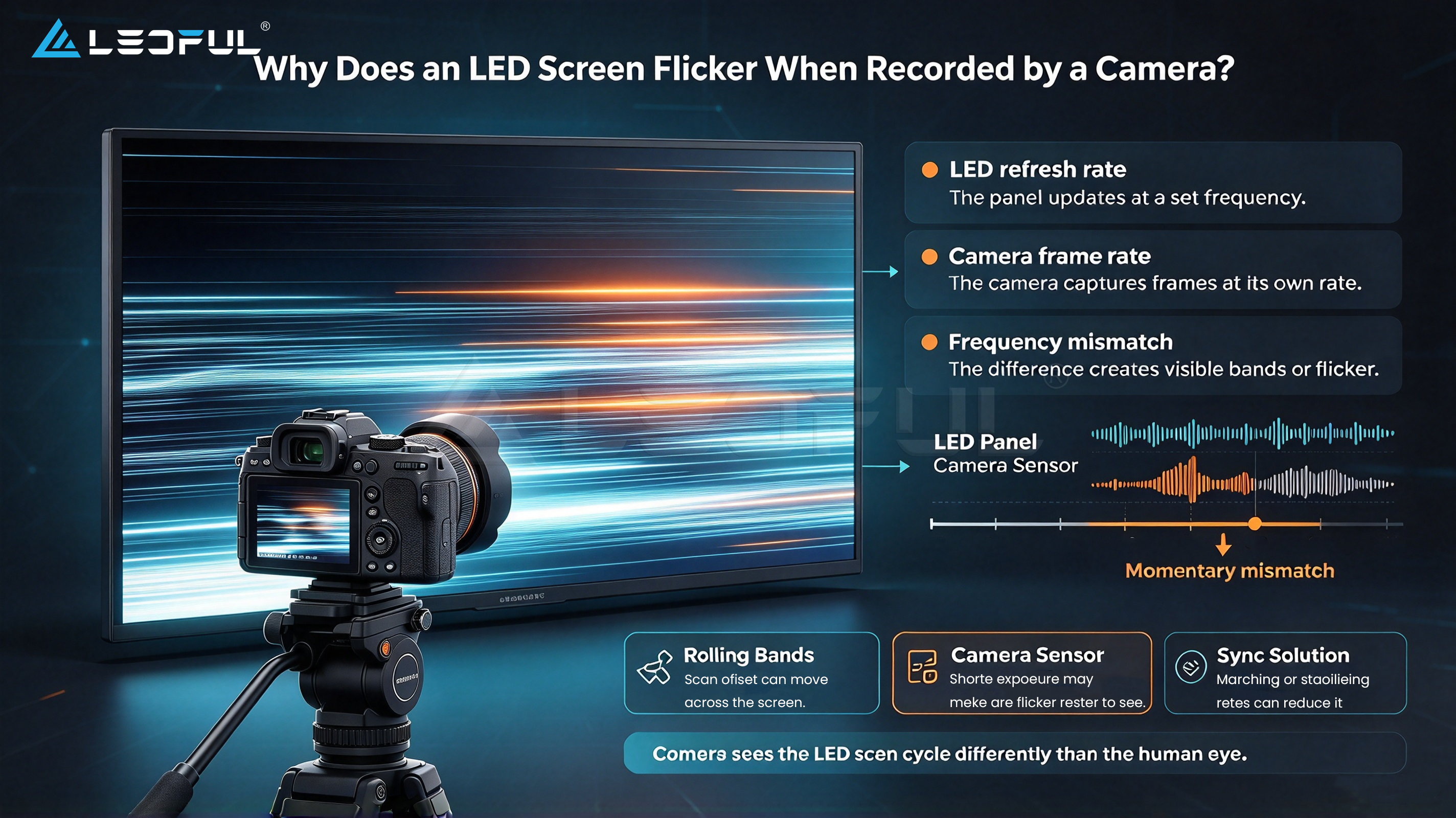
The LED wall may be captured directly by professional cameras, so factors such as:
– Refresh rate
– Scan mode
– Camera shutter interaction
– Moiré control
– Color accuracy
– Grayscale performance
– Pixel pitch
– Processor performance
can become critical.
A high-resolution LED wall can be useful, but 4K resolution alone does not guarantee broadcast quality.
The complete LED system must be designed for camera capture.
Retail & Commercial
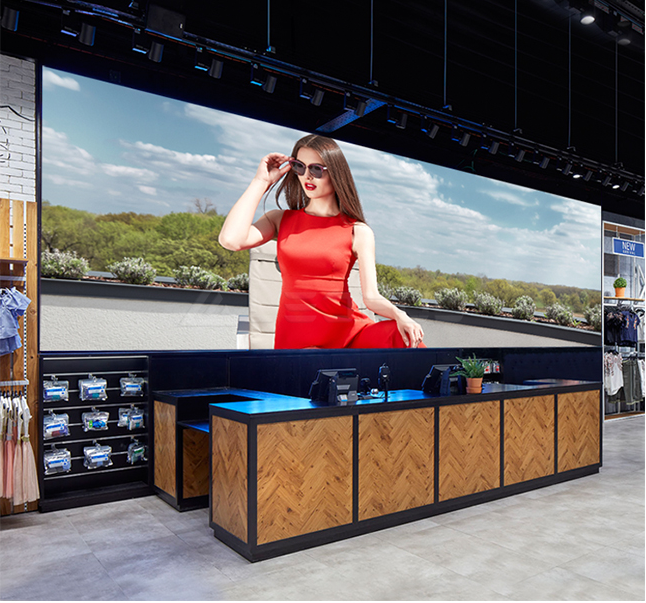
Retail environments often use LED displays to create large visual impact.
The appropriate resolution depends on:
– Store size
– Customer viewing distance
– Screen location
– Content type
– Brand requirements
– Whether customers can walk directly next to the display
For a large advertising screen viewed from several meters away, a very fine pixel pitch may provide limited additional value.
For a premium retail wall viewed at close range, a finer pitch can create a more seamless visual experience.
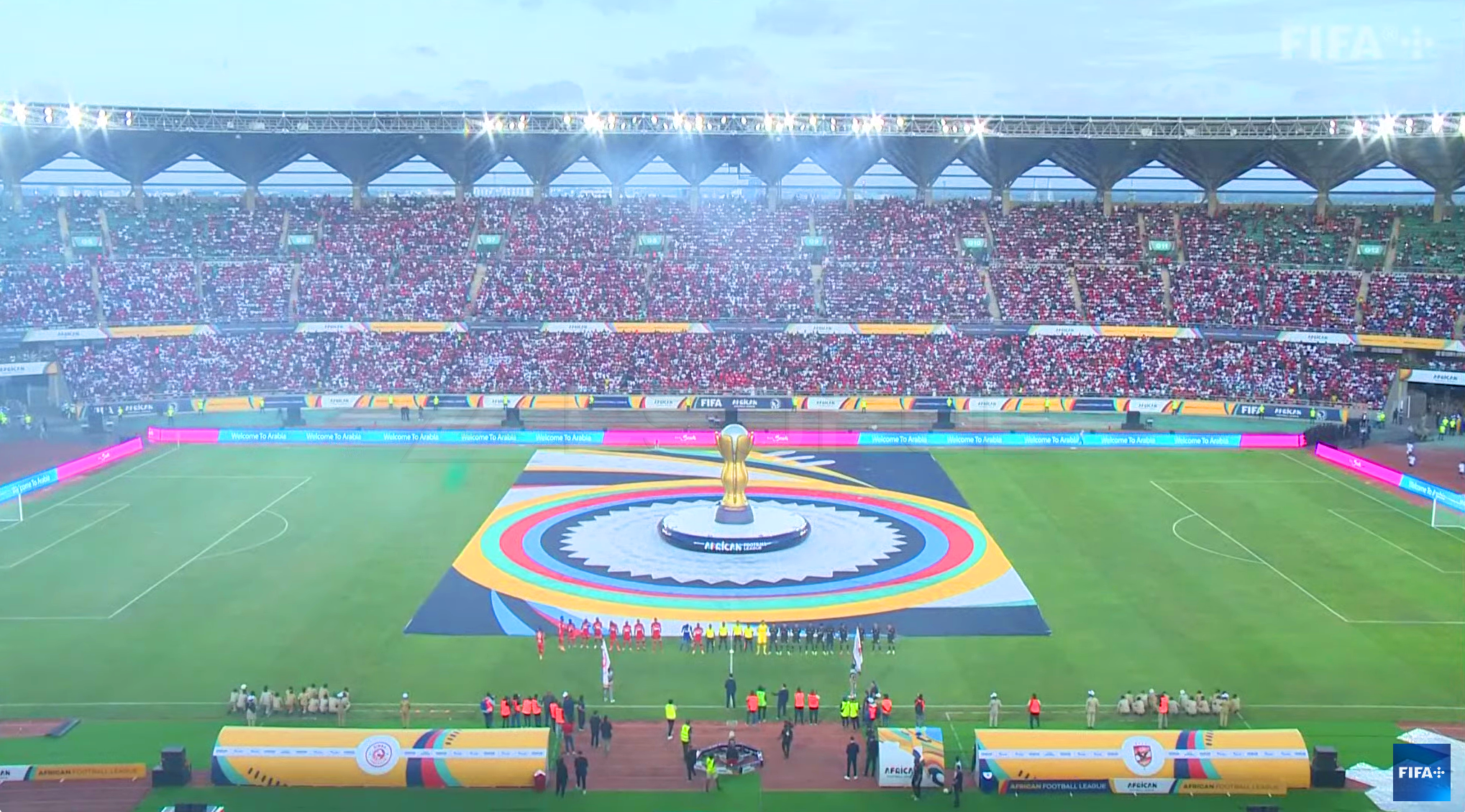
Stadiums & Large Outdoor Screens
Stadium and outdoor LED displays typically prioritize visibility over extreme pixel density.
Important factors may include:
– Brightness
– Contrast
– IP protection
– Refresh rate
– Viewing angle
– Impact resistance
– Weather resistance
– Serviceability
– Pixel pitch
A large outdoor display may not need native 4K to deliver effective viewing for spectators located dozens of meters away.
In these projects, the viewing distance and screen size often have a greater influence on the appropriate pixel pitch than the desire to use a “4K” label.
5 Factors Before Buying a 4K LED Display
Before requesting a quotation, evaluate these five factors.
1. Viewing Distance
The closest viewing distance is one of the most important variables.
A screen designed for a viewer standing one meter away has very different requirements from a stadium display viewed from 50 meters away.
The closer the viewer, the more visible individual pixels become.
Therefore, pixel pitch should be selected based on the actual viewing environment rather than simply choosing the smallest available pitch.
2. Screen Size
Screen size determines how many physical pixels can fit into the display.
A small P1.2 LED wall and a large P2.5 LED wall can both be designed for high-resolution applications, but their physical pixel counts and dimensions will be different.
The screen width and height should therefore be considered together with pixel pitch.
3. Pixel Pitch
Pixel pitch is one of the most important specifications in LED display selection.
A smaller pitch generally provides:
– Higher pixel density
– Higher potential image detail
– Shorter suitable viewing distance
But it can also mean:
– Higher cost
– More LEDs
– Higher data-processing requirements
– Greater sensitivity to manufacturing consistency
The goal is not to choose the smallest pitch. The goal is to choose the pitch that fits the project.
4. Content Resolution
What will actually be displayed?
If the majority of content is 1080P, installing a native 4K wall may not deliver the full benefit expected from the additional physical pixels.
If the project regularly uses:
– 4K video
– High-resolution product imagery
– Detailed graphics
– Large presentation content
– Virtual production backgrounds
then higher native resolution may be more valuable.
5. Processing & Signal Infrastructure
A high-resolution LED wall also requires an appropriate processing and signal system.
Before purchasing, confirm:
– Video processor capability
– Input resolution
– Output resolution
– Refresh rate
– Signal transmission distance
– Controller capacity
– Video source capability
– Redundancy requirements
A 4K LED wall is not just a display hardware purchase. It is a complete signal and display system.
How Much Does a 4K LED Display Cost?
There is no universal price for a 4K LED wall.
The total project cost depends on factors such as:
– Pixel pitch
– Screen size
– Native resolution
– LED package
– SMD / COB technology
– Brightness
– Cabinet design
– Front or rear service
– Refresh rate
– Receiving cards
– Video processor
– Installation structure
– Control system
– Redundancy
– Installation and commissioning
– Transportation
– Spare parts
– Warranty and service
A smaller fine-pitch 4K wall can require a very different budget from a large P2.5 or P3.9 LED wall.
For procurement, it is better to compare complete system specifications and total project cost rather than comparing only the price per square meter.
How to Choose the Right 4K LED Display
A practical selection process is:
Step 1: Define the application
Conference room, broadcast studio, retail, showroom, stadium, control room, or another environment.
Step 2: Measure the screen area
Confirm the required width and height.
Step 3: Identify the closest viewing distance
This helps determine the appropriate pixel pitch.
Step 4: Review the content
Confirm whether the source content is HD, 4K, or mixed resolution.
Step 5: Calculate the native LED resolution
Do not assume that a 4K input means a native 4K LED wall.
Step 6: Select the processing system
Make sure the processor and signal chain can handle the required resolution, refresh rate, and input sources.
Step 7: Review installation and maintenance
Check front/rear service access, cabinet structure, spare parts, power distribution, and service requirements.
Step 8: Compare suppliers
Evaluate product specifications, manufacturing capability, quality control, warranty, project experience, and technical support—not just the initial quotation.
Why Work With an LED Display Manufacturer?
For projects requiring a specific resolution, pixel pitch, cabinet configuration, or installation environment, working directly with an experienced LED display manufacturer can simplify system design.
LEDFUL can evaluate the project based on:
– Screen dimensions
– Indoor or outdoor environment
– Closest viewing distance
– Content type
– Required resolution
– Brightness
– Refresh rate
– Cabinet configuration
– Installation and maintenance conditions
This project-based approach helps avoid selecting a product simply because it carries a “4K” label.
For B2B buyers, the goal should be a display system that matches the actual project requirements. https://www.ledful.com/product-category/outdoor
FAQ: 4K LED Display
- What is a 4K LED display?
A 4K LED display generally refers to an LED display with a resolution of approximately 3840 × 2160 pixels. However, buyers should confirm whether “4K” means native LED resolution or simply 4K input support.
- Is 4K better than 1080P for an LED display?
4K provides approximately four times the pixel count of 1080P. Whether viewers can see a meaningful difference depends on screen size, viewing distance, content, and display quality.
- Does pixel pitch affect 4K resolution?
Yes. Pixel pitch determines how many physical pixels can fit into a given screen area. Smaller pitch allows higher pixel density.
- What pixel pitch is needed for a 4K LED wall?
There is no single answer. The required pitch depends on screen dimensions and the desired native resolution. Viewing distance should also be considered.
- Can a P2.5 LED display be 4K?
Yes, if the physical screen is large enough to contain approximately 3840 × 2160 pixels and the cabinet configuration allows it. A smaller P2.5 wall may accept 4K content without having native 4K resolution.
- Is a 4K LED wall necessary for a conference room?
It depends on screen size, viewing distance, content, and presentation requirements. Close-viewing conference environments may benefit from higher pixel density.
- Does 4K improve LED display image quality?
Resolution is only one part of image quality. Brightness, contrast, color consistency, grayscale, refresh rate, processing, calibration, and content quality also matter.
- Does a 4K processor make an LED wall 4K?
No. A processor can accept and process a 4K signal while the physical LED wall has a lower native resolution.
- Is a 4K LED display more expensive?
Often, yes, because higher pixel density can require more LED pixels, more processing capacity, finer-pitch components, and a larger system investment. However, the final price depends on the complete project configuration.
- How do I choose the right 4K LED display supplier?
Compare technical specifications, manufacturing capability, quality control, project experience, warranty, spare-parts support, technical service, and the supplier’s ability to design the complete display system around your project.
Planning a 4K LED Display Project?
Before asking for a quotation, prepare these five details:
– Screen width and height
– Indoor or outdoor application
– Closest viewing distance
– Main content type
– Expected installation timeline
Send these details to LEDFUL and the technical team can recommend the appropriate pixel pitch, native resolution, cabinet configuration, processing system, and overall LED display solution.
A 4K LED wall should be specified by project requirements—not simply by the 4K label.