























How much electricity does an LED screen use?
This is one of the most common questions asked before purchasing an LED display. Whether you are planning an outdoor billboard, indoor advertising screen, stadium display, retail LED wall, church screen, or large-format digital signage project, power consumption directly affects both electrical infrastructure and long-term operating costs.
However, calculating LED display electricity consumption is not as simple as multiplying the screen size by the maximum power listed on a specification sheet.
An LED display typically has both maximum power consumption and average power consumption, and the actual electricity used depends on screen size, brightness, content, operating hours, environmental conditions, and display settings.
This guide explains how LED display power consumption is calculated, how much electricity different LED screens may use, how to estimate electricity costs, and how to choose a more energy-efficient LED display solution.
How Much Electricity Does an LED Screen Use?
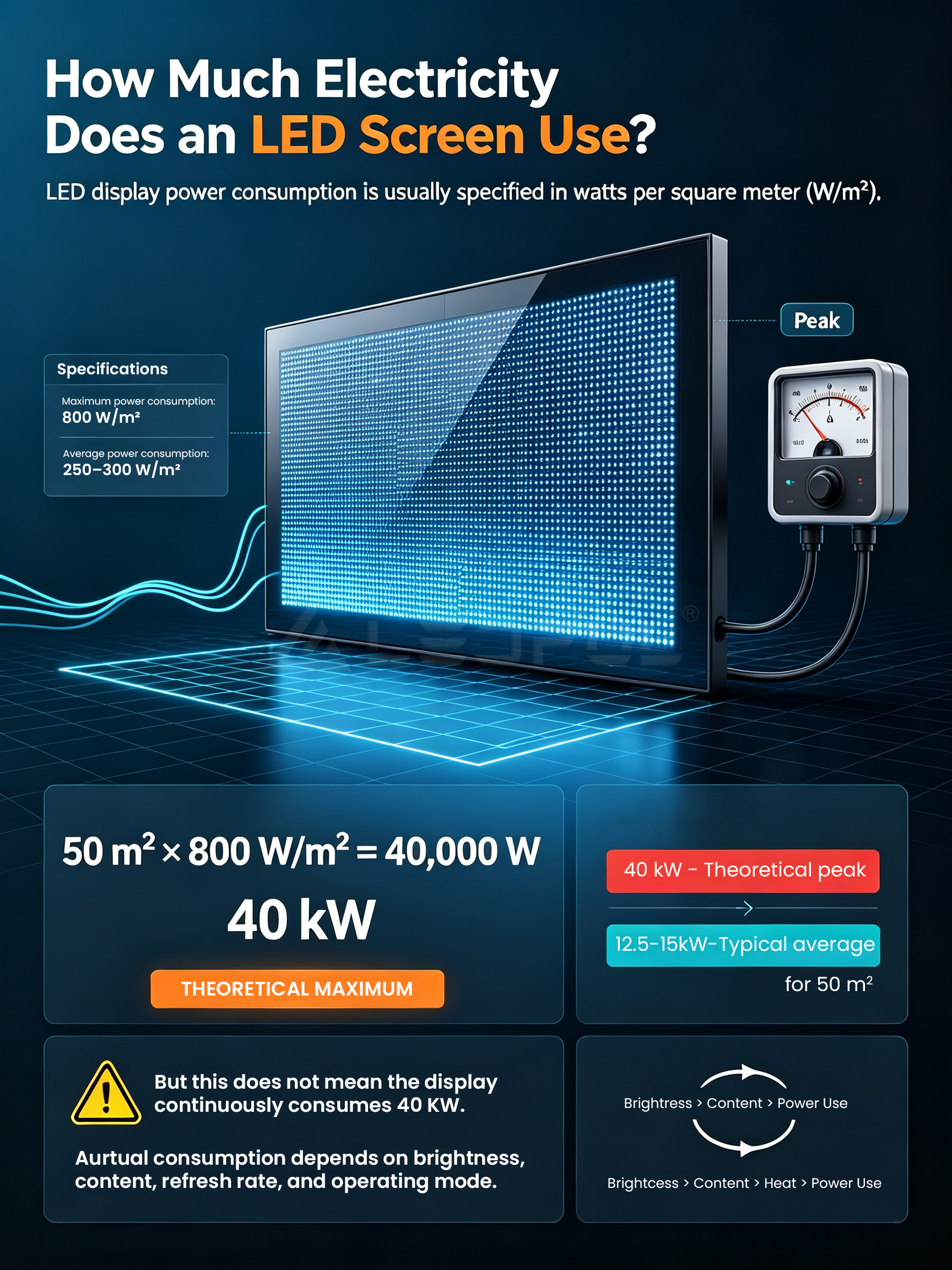
LED display power consumption is usually specified in watts per square meter (W/m²).
For example, an LED display specification might state:
- Maximum power consumption: 800 W/m²
- Average power consumption: 250–300 W/m²
If the screen area is 50 m², the theoretical maximum power would be:
50 m² × 800 W/m² = 40,000 W
or:
40 kW
But this does not mean the display continuously consumes 40 kW.
In actual operation, the display may consume considerably less depending on brightness, displayed content, operating conditions, and system efficiency.
This is why it is important to understand the difference between maximum power consumption and average power consumption.
Maximum Power Consumption vs. Average Power Consumption
These two figures are often confused when customers compare LED displays.
What Is Maximum Power Consumption?
Maximum power consumption represents a high-load operating condition.
It is useful when engineers need to calculate:
- Power distribution
- Cable sizing
- Circuit capacity
- Power supply requirements
- Electrical safety
- Backup power requirements
- Maximum load
For example, if an LED display has a maximum power consumption of 800 W/m², engineers can use this figure to calculate the maximum electrical load of the system.
However, the display will not necessarily operate at this maximum level continuously.
What Is Average Power Consumption?
Average power consumption is a more useful figure for estimating actual operating electricity usage.
The actual consumption depends on:
- Brightness
- Content
- Screen configuration
- Operating hours
- LED efficiency
- Environmental conditions
- Power management
- Display settings
A screen showing mostly dark content can consume less power than a screen displaying bright white content at high brightness.
Therefore:
Maximum power is mainly used for electrical system design, while average power is more useful for estimating operating costs.
How to Calculate LED Screen Power Consumption
The basic calculation is straightforward.
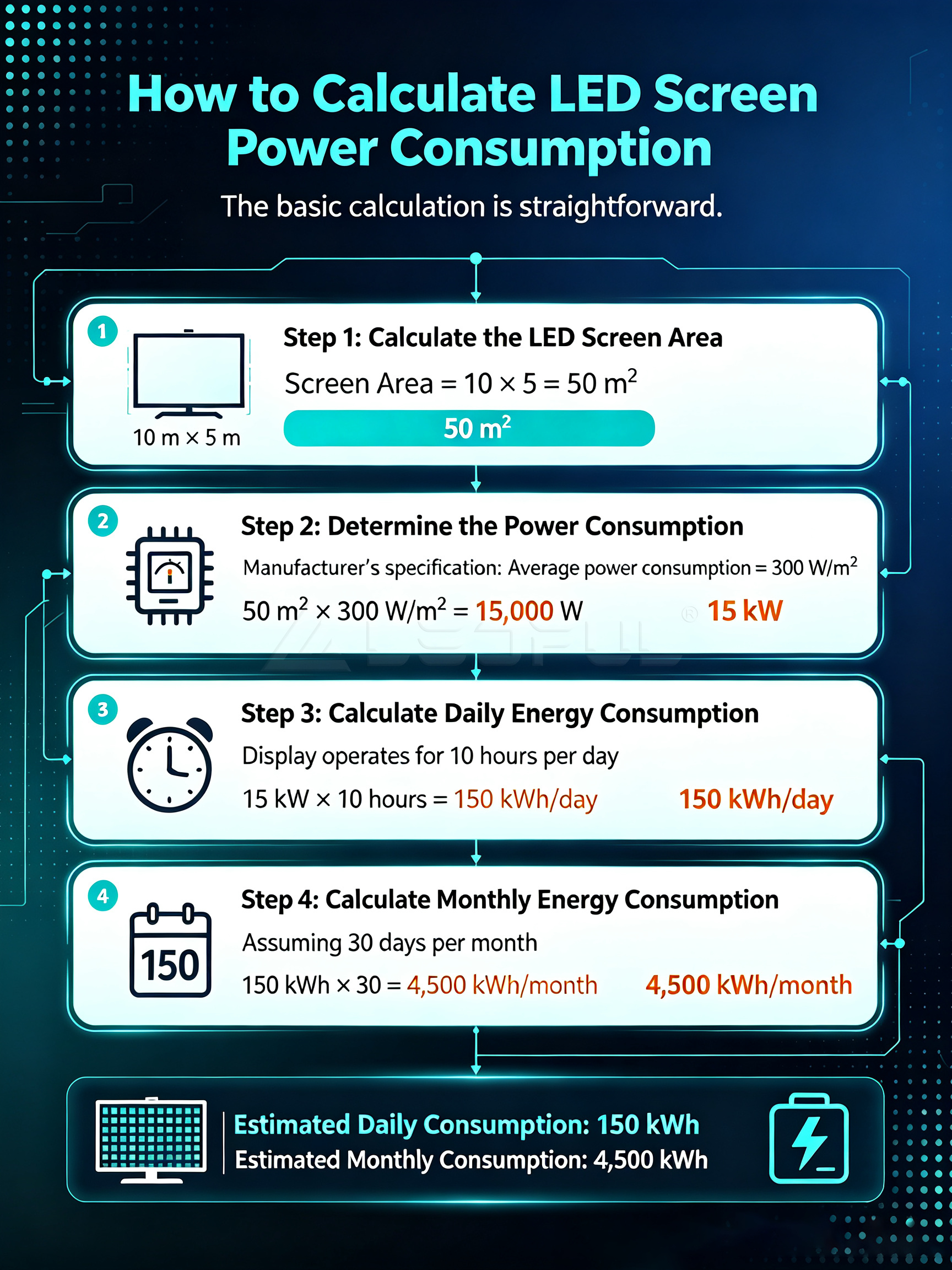
Step 1: Calculate the LED Screen Area
If the screen dimensions are:
10 m × 5 m
Then:
Screen Area = 10 × 5 = 50 m²
Step 2: Determine the Power Consumption
Assume the manufacturer’s specification is:
Average power consumption = 300 W/m²
Then:
50 m² × 300 W/m² = 15,000 W
or:
15 kW
Step 3: Calculate Daily Energy Consumption
If the display operates for 10 hours per day:
15 kW × 10 hours = 150 kWh/day
Therefore, the estimated daily electricity consumption is:
150 kWh
Step 4: Calculate Monthly Energy Consumption
Assuming the display operates 30 days per month:
150 kWh × 30 = 4,500 kWh/month
The estimated monthly consumption is therefore:
4,500 kWh
LED Display Power Consumption Formula
You can use the following formula for a quick estimate:
Daily Energy Consumption
Screen Area × Average Power Consumption × Operating Hours ÷ 1,000
Where:
- Screen Area = m²
- Average Power Consumption = W/m²
- Operating Hours = hours/day
- Result = kWh/day
Monthly Energy Consumption
Daily Energy Consumption × Operating Days
Example: How Much Electricity Does a 100 m² LED Screen Use?
Let’s consider a 100 m² LED display.
Assume:
- Screen area: 100 m²
- Average power consumption: 300 W/m²
- Operating time: 12 hours/day
- Operating days: 30 days/month
Step 1: Calculate Operating Power
100 × 300 W = 30,000 W
= 30 kW
Step 2: Calculate Daily Consumption
30 kW × 12 hours = 360 kWh/day
Step 3: Calculate Monthly Consumption
360 × 30 = 10,800 kWh/month
Therefore, under these assumptions:
Estimated monthly energy consumption = 10,800 kWh
This is an estimate rather than a guaranteed real-world figure. Actual consumption can vary depending on brightness, content, environmental conditions, and the specific LED display system.
LED Screen Electricity Consumption by Screen Size
The following example uses an assumed average power consumption of 300 W/m² and illustrates how screen area affects estimated energy consumption.
| Screen Area | Average Power | Operating Power | 10 Hours/Day | 30 Days |
| 10 m² | 300 W/m² | 3 kW | 30 kWh/day | 900 kWh/month |
| 20 m² | 300 W/m² | 6 kW | 60 kWh/day | 1,800 kWh/month |
| 50 m² | 300 W/m² | 15 kW | 150 kWh/day | 4,500 kWh/month |
| 100 m² | 300 W/m² | 30 kW | 300 kWh/day | 9,000 kWh/month |
| 200 m² | 300 W/m² | 60 kW | 600 kWh/day | 18,000 kWh/month |
These figures are examples for calculation purposes. Actual LED screen power consumption depends on the specific product and operating conditions.
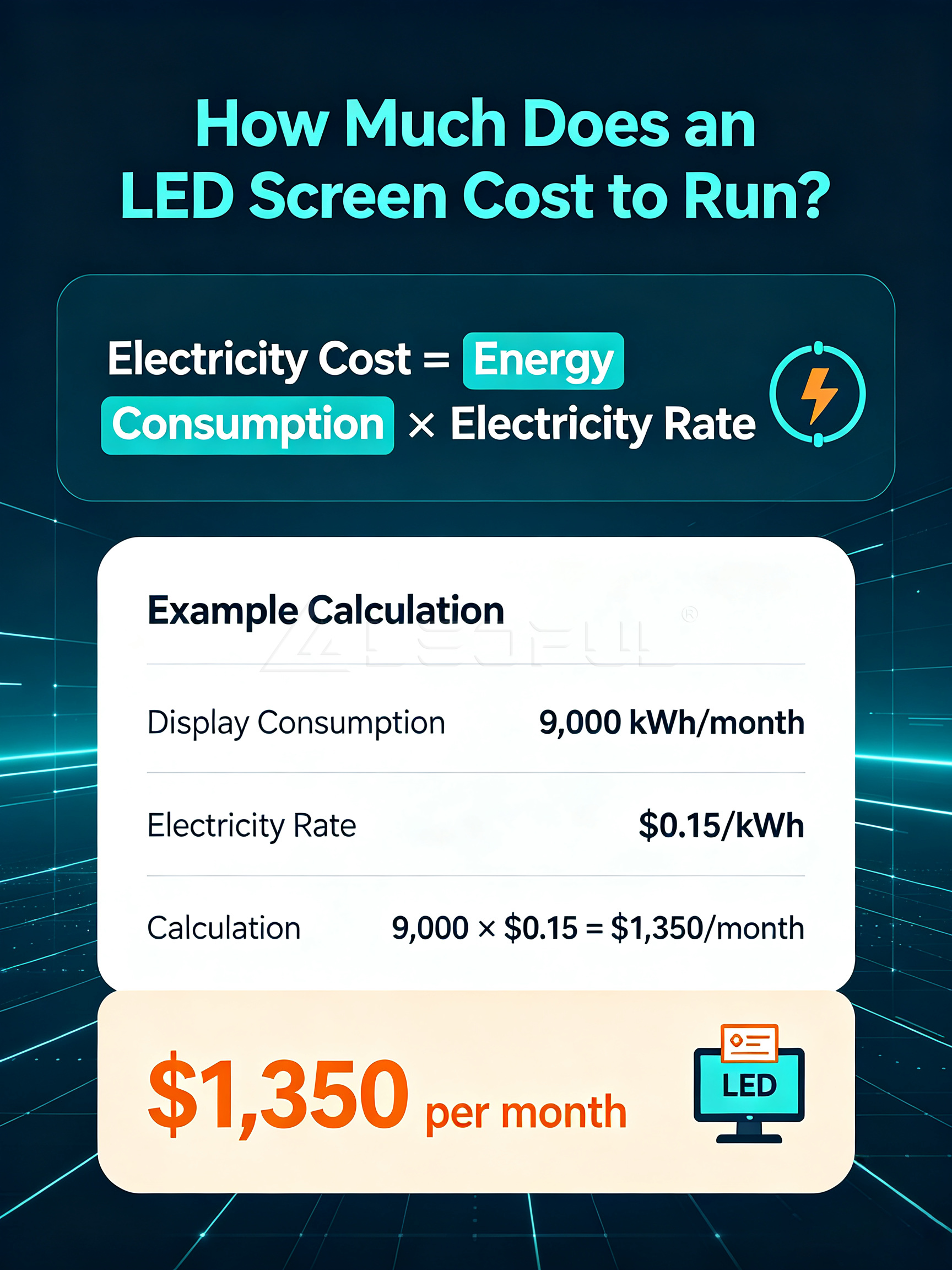
How Much Does an LED Screen Cost to Run?
Once you know the estimated energy consumption, you can calculate the electricity cost.
The basic formula is:
Electricity Cost = Energy Consumption × Electricity Rate
For example, if a display consumes:
9,000 kWh/month
and the electricity rate is:
$0.15/kWh
Then:
9,000 × $0.15 = $1,350/month
The estimated electricity cost would be:
$1,350 per month
However, electricity prices vary significantly between countries, regions, commercial buildings, and utility plans.
For an accurate project estimate, always use the actual electricity rate applicable to the installation site.
What Factors Affect LED Display Power Consumption?
Screen area is only one part of the calculation.
Several other factors can significantly affect actual energy usage.
1. Screen Brightness
Brightness is one of the most important factors.
A display operating at high brightness generally requires more power than the same display operating at a lower brightness level.
For example:
- Outdoor advertising screens may require high brightness during daylight.
- Indoor displays usually require lower brightness.
- Nighttime outdoor operation may allow brightness to be reduced.
A properly configured brightness schedule can therefore help reduce unnecessary energy consumption.
2. Display Content
The displayed content also affects power consumption.
Bright images, large white areas, and high-intensity content generally require more LED output than dark content.
For example, a screen showing:
White background + bright graphics
may consume more power than one showing:
Dark background + limited bright elements
This is one reason why average power consumption can differ significantly from the maximum power listed on the specification sheet.
3. Pixel Pitch
Pixel pitch describes the distance between LED pixels.
Common options include:
- 2
- 5
- 8
- 5
- 6
- 9
- 8
- 6
- P8
- P10
Pixel pitch itself should not be treated as a simple “lower pitch = higher power” rule.
Power consumption depends on the complete LED design, including:
- LED components
- Driver ICs
- PCB design
- Module structure
- Power supply efficiency
- Brightness
- Refresh requirements
Therefore, compare the actual W/m² specification when evaluating energy consumption.
4. LED Efficiency
The efficiency of LED components and driver electronics affects how much electrical power is required to produce a certain brightness level.
A more efficient display system can help reduce long-term operating costs.
When comparing LED displays, consider both:
Brightness performance + Power consumption
rather than looking at either specification separately.
5. Operating Hours
A screen operating 6 hours per day will naturally consume less electricity than one operating 18 hours per day.
For commercial projects, it is useful to calculate consumption based on the actual schedule:
- 8 hours/day
- 10 hours/day
- 12 hours/day
- 16 hours/day
- 24 hours/day
This provides a more realistic estimate of annual operating costs.
6. Environmental Conditions
Outdoor LED displays may operate under significantly different conditions from indoor displays.
Factors such as:
- Ambient temperature
- Cooling requirements
- Brightness
- Weather
- Ventilation
- Cabinet design
can affect overall system energy requirements.
For outdoor installations, power consumption should therefore be considered together with the complete electrical and thermal design.
How to Reduce LED Screen Energy Consumption
Reducing energy consumption does not necessarily mean choosing the lowest-power LED display.
The better approach is to match the display configuration to the actual application.
1. Use Appropriate Brightness
Do not operate an indoor LED screen at unnecessary brightness.
For outdoor displays, use brightness control based on:
- Daytime
- Evening
- Nighttime
- Weather conditions
- Local environment
Automatic brightness adjustment can help prevent unnecessary energy usage.
2. Optimize Operating Hours
If the LED display does not need to operate 24 hours a day, schedule operating periods according to actual business requirements.
For example:
Retail Store
Operating hours: 10:00–22:00
Instead of:
00:00–24:00
Reducing unnecessary operating hours can directly reduce electricity consumption.
3. Compare Average Power Consumption
When evaluating LED products, do not compare only maximum power.
Ask manufacturers for:
- Maximum power consumption
- Average power consumption
- Brightness level used for the measurement
- Test conditions
This provides a more meaningful comparison between different LED displays.
4. Consider Common Cathode LED Technology
For applications where energy efficiency is a major concern, common cathode LED technology can be considered.
Common cathode architecture can improve power management by controlling different LED colors more efficiently.
However, the actual energy-saving performance depends on the complete display design and operating conditions.
Therefore, customers should evaluate the manufacturer’s actual product specifications rather than assuming a fixed percentage of energy savings.
5. Choose the Right LED Display for the Application
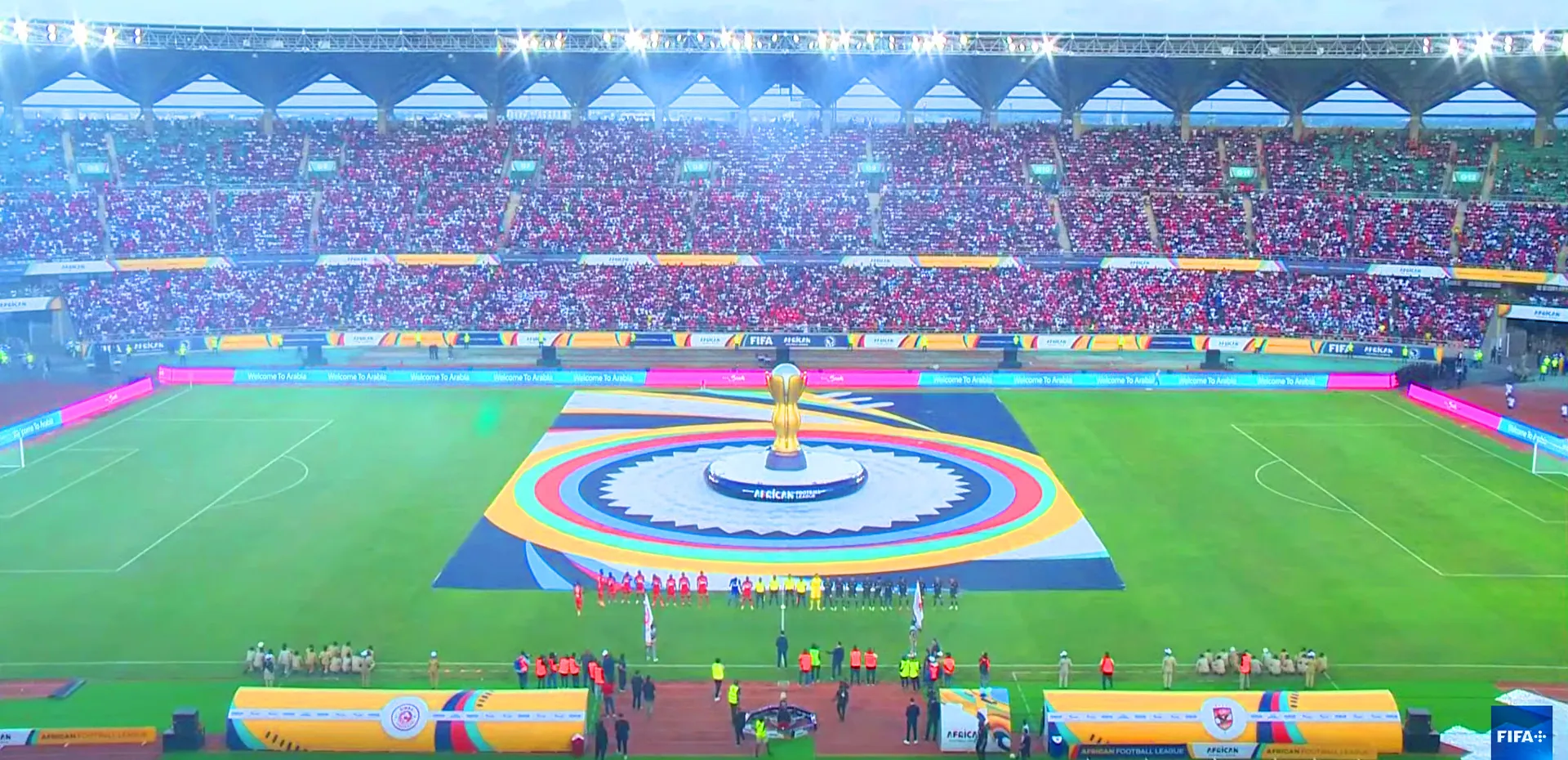
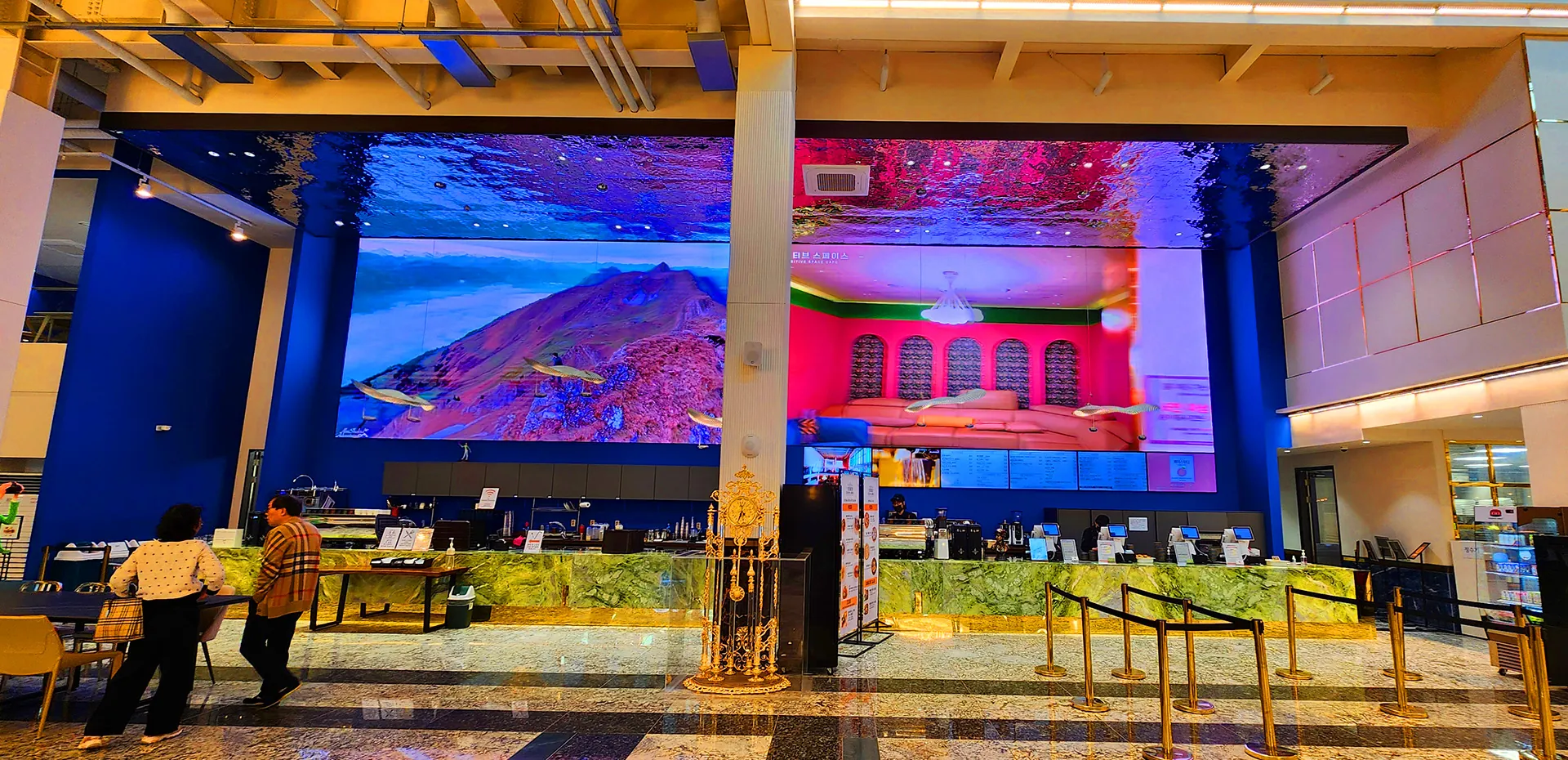
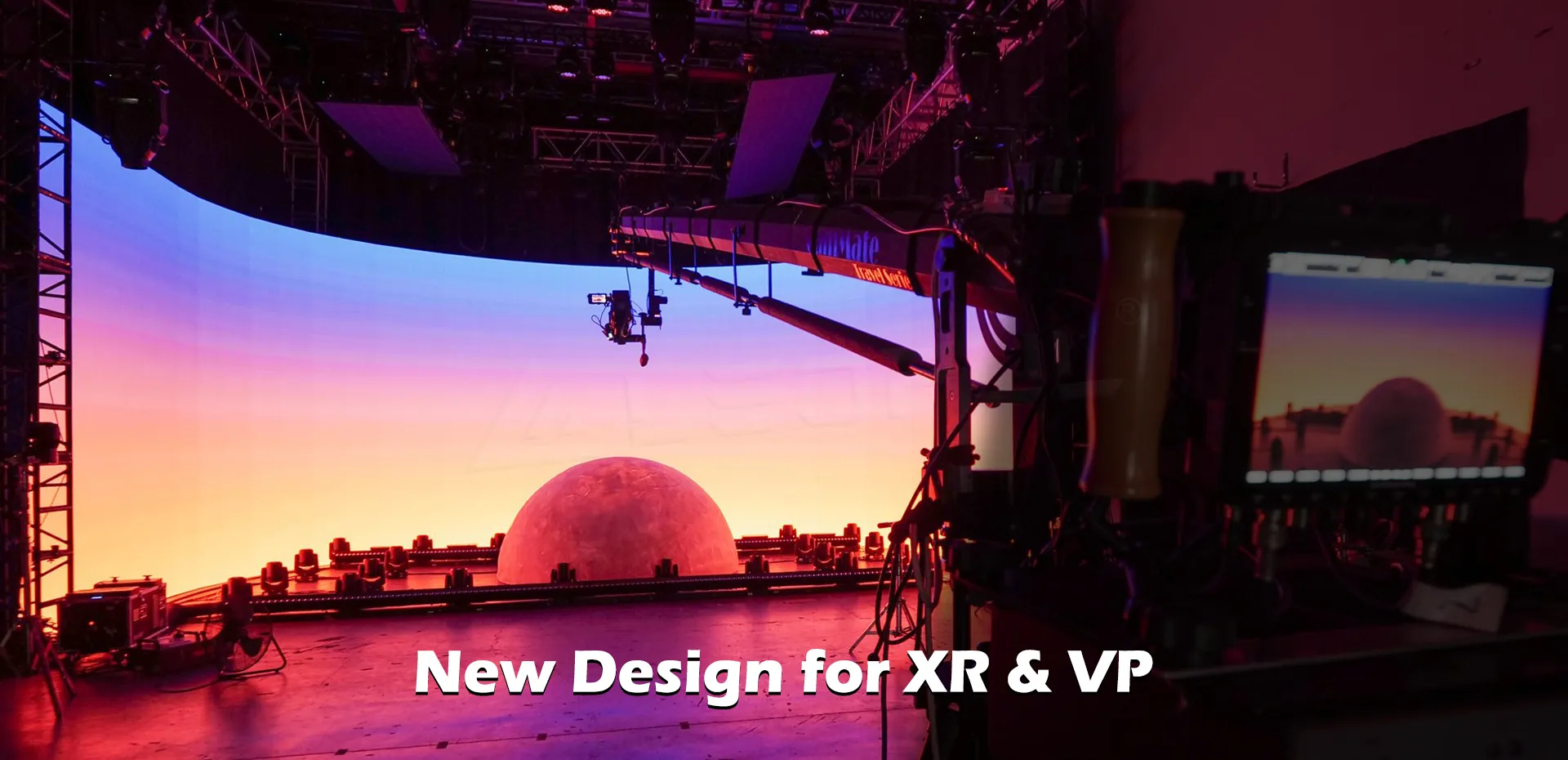
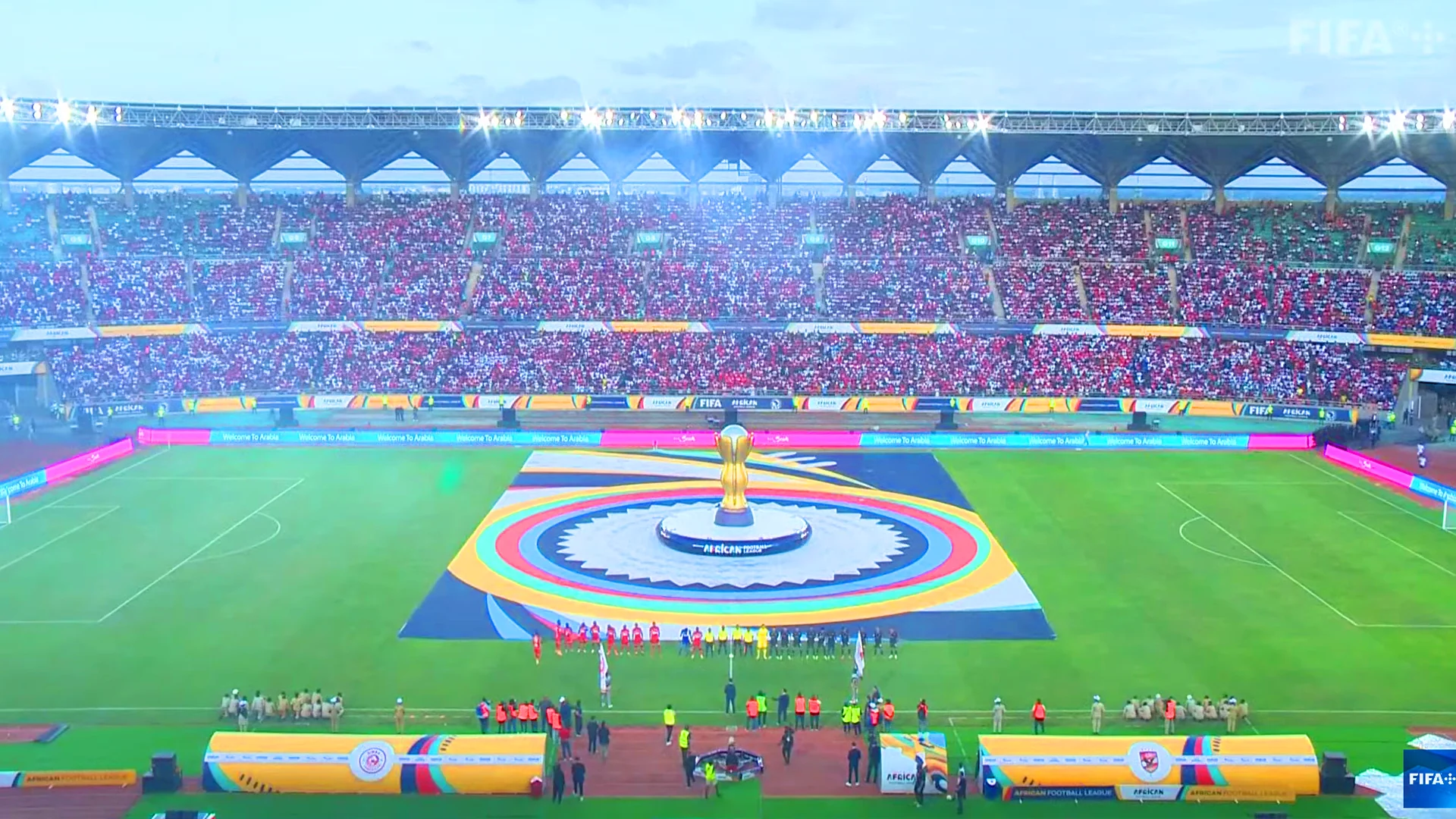
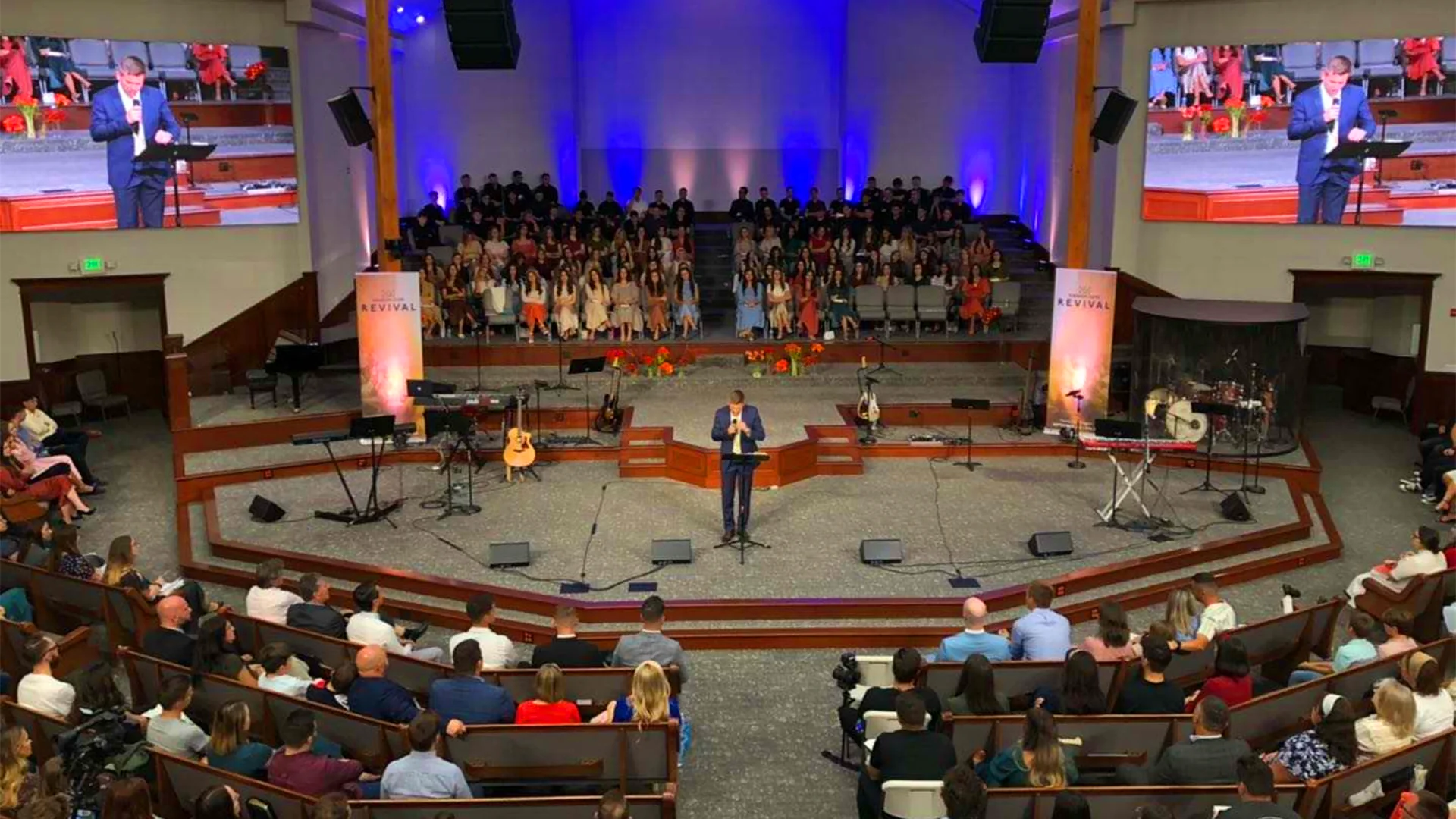
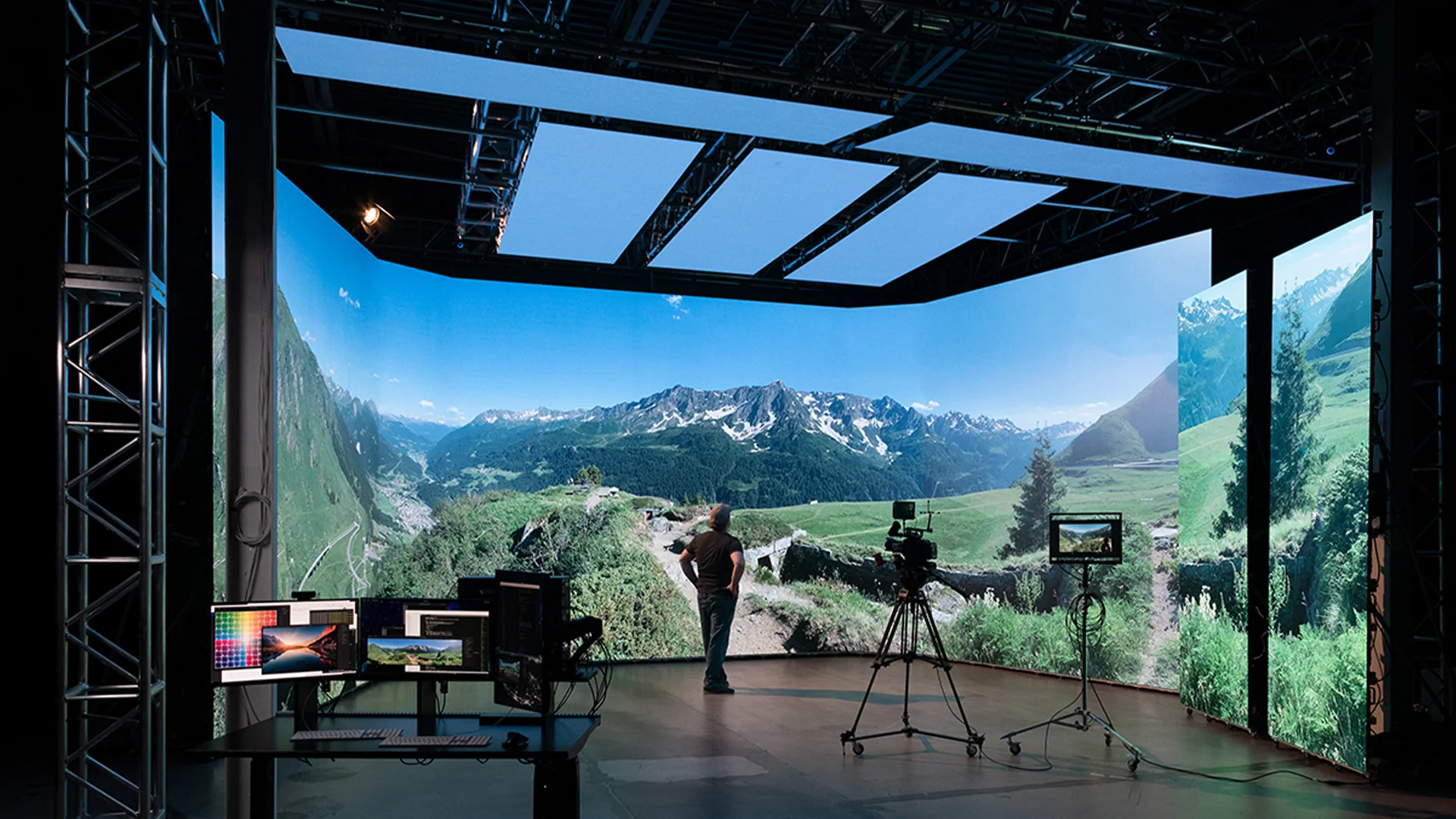
A large outdoor billboard, indoor retail screen, stadium perimeter display, and XR studio LED wall have completely different requirements.
Choosing a display designed for the actual application can help avoid unnecessary:
- Brightness
- Power capacity
- Cooling requirements
- Hardware
- Operating costs
The most energy-efficient solution is often the one that is correctly matched to the project.
LED Screen Power Consumption: What Should You Ask the Manufacturer?
Before purchasing an LED display, ask the supplier for more than the screen price.
Request the following information:
Electrical Specifications
- Maximum power consumption
- Average power consumption
- Operating voltage
- Power supply efficiency
- Power factor
- Maximum current
- Recommended power distribution
Display Specifications
- Pixel pitch
- Brightness
- Refresh rate
- LED type
- Driver IC
- Cabinet size
- IP rating
Project Information
- Recommended operating hours
- Brightness settings
- Environmental conditions
- Cooling requirements
- Installation requirements
This information allows engineers to estimate both the initial electrical infrastructure and the long-term operating cost.
Maximum Power vs. Average Power: Which One Should You Use?
This is one of the most important questions when calculating LED display electricity consumption.
Use maximum power consumption when you are designing:
- Electrical circuits
- Power distribution
- Cables
- Breakers
- Backup power
- Generators
- Infrastructure capacity
Use average power consumption when estimating:
- Daily electricity consumption
- Monthly electricity consumption
- Annual operating costs
- Total cost of ownership
For a professional project, both figures are important.
Frequently Asked Questions
How much power does an LED screen use per square meter?
Power consumption varies by LED display model, brightness, pixel pitch, technology, and application. The manufacturer’s specification should be used for an accurate estimate. LED displays are commonly specified in W/m².
How do I calculate LED screen electricity consumption?
Multiply the screen area by average power consumption and operating hours, then divide by 1,000 to convert watts into kilowatt-hours.
Formula:
Area × Average W/m² × Hours ÷ 1,000 = kWh
Does an LED screen use more electricity at higher brightness?
Generally, yes. Higher brightness typically requires more electrical power. Actual consumption depends on the LED system, content, brightness control, and operating conditions.
Is maximum power consumption the actual electricity consumption?
No. Maximum power represents a high-load condition and is primarily useful for electrical infrastructure design. Actual operating consumption is usually lower and depends on brightness, content, and operating conditions.
How much electricity does a 10 m² LED screen use?
It depends on the product’s average power consumption and operating hours. For example, at an assumed 300 W/m² average power and 10 hours of daily operation:
10 × 300 × 10 ÷ 1,000 = 30 kWh/day
The actual figure depends on the specific LED display.
How much does an LED screen cost to run per month?
Multiply the estimated monthly energy consumption by the local electricity rate.
Monthly Cost = Monthly kWh × Electricity Rate
Because electricity rates vary by location, the final cost should be calculated using the actual local commercial electricity price.
Does pixel pitch affect LED screen power consumption?
Pixel pitch can affect the design and electrical characteristics of an LED display, but it is not reliable to estimate power consumption from pixel pitch alone. Always compare the manufacturer’s specified power consumption in W/m².
How can I reduce LED display electricity consumption?
The most practical methods include optimizing brightness, reducing unnecessary operating hours, using appropriate display settings, selecting energy-efficient components, and choosing an LED display correctly matched to the application.
LED Display Power Consumption Calculator
For an LED display project, you can estimate energy consumption using four basic inputs:
- Screen Area:___ m²
- Average Power Consumption:___ W/m²
- Operating Hours:___ hours/day
- Operating Days:___ days/month
Then calculate:
Daily Consumption
Area × Average W/m² × Hours ÷ 1,000
Monthly Consumption
Daily kWh × Operating Days
Monthly Electricity Cost
Monthly kWh × Local Electricity Rate
For a professional project, LEDFUL recommends confirming the manufacturer’s actual average and maximum power specifications before finalizing electrical infrastructure.
Why Choose LEDFUL for Your LED Display Project?
LEDFUL is a professional LED display manufacturer providing LED display solutions for different commercial and professional applications. https://www.ledful.com/category/solutions
LEDFUL’s product portfolio covers solutions for:
- Outdoor advertising
- Chain retail
- Churches
- Stadiums
- Conference rooms
- XR virtual production
- Indoor digital signage
- Rental applications
- Creative LED installations
For each project, power consumption should be evaluated together with the required:
Brightness + Pixel Pitch + Screen Size + Operating Hours + Environment + Application
LEDFUL can help project teams select an appropriate LED display configuration and provide the technical specifications required for project planning.
The goal is not simply to find an LED screen with the lowest power consumption.
The goal is to find the right balance between display performance, energy consumption, installation requirements, and total cost of ownership.
Final Takeaway
LED display electricity consumption depends on much more than screen size.
The most important factors include:
- Screen area
- Average power consumption
- Maximum power consumption
- Brightness
- Display content
- Operating hours
- LED technology
- Environmental conditions
- Power supply efficiency
When planning an LED display project, use maximum power consumption to design the electrical infrastructure and average power consumption to estimate actual operating costs.
If you are planning an LED billboard, digital signage project, stadium display, retail LED screen, church display, XR LED wall, or other commercial LED installation, LEDFUL can help you evaluate the appropriate display solution and estimate the electrical requirements for your project.
Need help calculating your LED display power consumption?
Contact LEDFUL with your screen size, application, operating hours, and target brightness, and the LEDFUL team can help you evaluate the appropriate LED display solution.